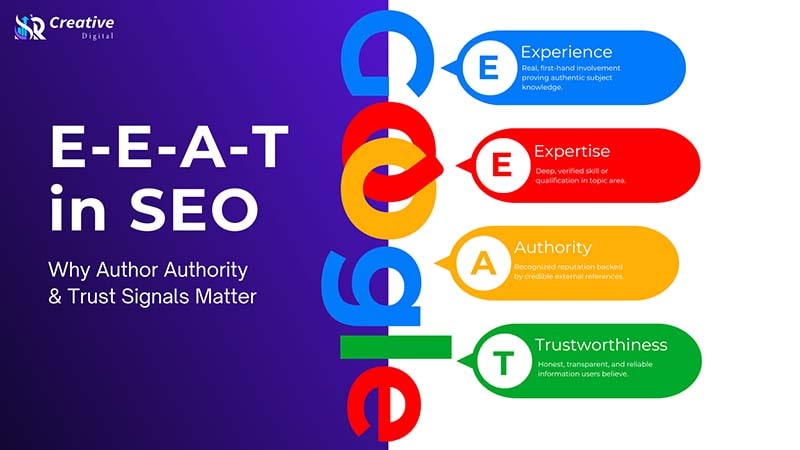
As the SEO landscape changes continuously, one acronym has gained notable importance: E‑E‑A‑T. The acronym denotes the four components as Experience, Expertise, Authoritativeness, and Trustworthiness, and shows the model that Google (and other search engines) use to figure out the quality of the web content they get.
To Google, E-E-A-T is not a directly measurable ranking factor. However, it is extremely important to the process when Google’s systems are used to decide if the content is of a credible, useful, and worthy can be given a higher ranking in the results of a search.
Here, we would be going way beyond the surface in explaining what E-E-A-T is, the importance of E-E-A-T in SEO (particularly for “YMYL” topics), the way author authority and trust signals work together with E-E-A-T, and some real-life steps you can take to create an E-E-A-T optimized webpage. This article is crafted to be SEO-friendly, rich in semantic optimisation, and structured for long-term value.
What E-E-A-T Means
1. Experience
The main “E” in the E-E-A-T acronym is Experience — the author’s direct, first-hand encounter with the topic. It is the latest addition to the original E-A-T, which was developed quite some time ago.
Personal, concrete experience of the author is the main idea that distinguishes the statements, for example, “I visited 20 countries and here’s what happened” vs. “I interviewed someone.” Just by reading the former, one can feel that the credibility level is higher than in the latter case. A lot of SEO specialists consider this factor as a single point of difference in their field, which is the content of a new nature.
2. Expertise
Expertise is the author’s depth of knowledge, credentials, or skill in the subject area. It is the main point that is supported by the evidence in the passage: Does the writer know what they’re talking about?
Take a medical case, for instance, if the content is written or checked by a qualified healthcare professional, then it is undoubtedly more credible as compared to a random “health blogger” without any credentials.
3. Authoritativeness
Authoritativeness is not only limited to an individual’s knowledge: it basically gauges the author’s or the website’s standing in the community. Are they acknowledged by others in the same field? Are they considered a ”source from which you get the most reliable information”?
These are basically signals to the extent that an author or a brand is treated as a source of authority by others, and it can be seen through inbound links, citations, endorsements, and mentions on trustworthy sites.
4. Trustworthiness
Trust is the base of the pyramid: the creator and the site have to be honest, transparent, secure, and reliable. If the audience is not able to trust the content, then the other three factors have no value.
For example, trust may be established by a website having secure protocols (HTTPS), detailed author biographies, providing contact information, giving correct information, referencing the sources, not making up sensational claims, and being honest about affiliate relationships.
Why E-E-A-T Matters for SEO
While E-E-A-T is not a direct ranking signal (i.e., there isn’t a particular “E-E-A-T score” in Google’s algorithm), it is fundamentally linked to the way Google assesses content through its Search Quality Rater Guidelines.
Essentially, E-E-A-T influences SEO performance in the following ways:
- As a Quality Signal: For topics that can have a major influence on a user’s health, finances, or safety (referred to as YMYL – Your Money or Your Life), Google sets higher quality requirements, and E-E-A-T matters a lot.
- Ranking & Visibility: Pages that clearly demonstrate strong E-E-A-T tend to perform better in search results, as they are the most likely to meet user intent, get references, and decrease bounce rates.
- Resilience to Algorithm Updates: Proper E-E-A-T implies that a website has fewer ‘thin’ or low-quality pages, thus, the website is less likely to be affected by future Google core updates that are focused on content quality.
- User-Centric Content: Content that is truly helpful and not merely keyword optimized is getting more and more rewarded by search engines. E-E-A-T is in line with the production of people-first content.
In short: if your goal is to keep your SEO success over the long period, you cannot disregard E-E-A-T anymore.
Author Authority & Trust Signals: Why They Matter
The Role of the Author
It is a fact that when a reader visits a page, they usually question (either consciously or subconsciously): “Who is the author? Can I trust them?”. An author bio that is well-structured – showing the credentials, the experience, and the previous work – is a perfect way to help answer that question. The author thus becomes the “face” of the content.
As a result, when you pinpoint and promote the writer:
- You prove that the content is a product of a real person and not an anonymous or AI-generated piece.
- You give the reader a reason to believe that the author is qualified (experience + expertise).
- You create an opportunity for trust to be established through the author’s background, reputation, and maybe even prior work or citations.
Trust Signals: What They Look Like
Here are some of the key trust signals that support E-E-A-T:
- HTTPS site, secure browsing
- Clear “About Us” page and contact info
- Author bio with credentials, years of experience, expertise
- Updated and accurate content, with citations or references to authoritative sources
- External links and inbound links from respected websites
- Customer reviews, testimonials, or third-party validation
- Avoidance of aggressive ads, disruptive pop-ups, affiliate disclosure when applicable
- Transparent editorial policy (especially in YMYL niches)
These cues tell both users and search engines that the site/author is legitimate and trustworthy, which supports the “T” and “A” in E-E-A-T.
Author Authority & Branding
Building author authority doesn’t happen overnight. Here are strategies:
- Encourage authors to have a public profile (LinkedIn, contributor bio, bylines) that links back to the site.
- Guest posting or authoring on niche-relevant sites increases reputation and network.
- Publishing in-depth, high-quality content which others link to or cite.
- Social proof: sharing articles, mentions, media coverage.
- Continuing education/certifications in the subject domain.
By establishing authors as authorities in their niche, you strengthen the content’s credibility and alignment with E-E-A-T.
How to Optimise Your Site & Content for E-E-A-T
Here’s a practical roadmap you can follow:
On-Page & Content Elements
- Use author bylines and bios — make it clear who wrote the piece, and what their background is.
- Highlight author credentials — degrees, certifications, years of experience, notable achievements.
- Demonstrate experience — include case studies, first-hand examples, personal stories, data sets.
- Cite reputable sources — link to primary research, official publications, trusted domains.
- Update content regularly — as industries change, content can become outdated, impacting trust.
- Use schema markup — Author, Article, Organization schema help search engines understand authorship and credibility.
- Transparent site elements — Privacy policy, About page, Terms and contact information.
- Avoid sensationalism — focus on accurate, useful, user-centric content, not clickbait.
Off-Page & Reputation Elements
- Get quality backlinks from proper, trustworthy websites. These, in turn, strengthen your authoritativeness.
- Get reviews and testimonials, if applicable (mainly for service businesses).
- Keep track of mentions of your brand and mentions of your authors all over the internet – consistency is one of the factors that help your reputation to grow.
- Make sure that your authors, for example, through guest posts, speaking engagements, or social profiles, can be found so that credibility can be established.
Technical / Sitewide Considerations
- Use HTTPS. Google points out that the most important things are security and trust.
- Make sure that your websites load fast, are friendly to mobile devices, and give the users an excellent experience (UX). Bad UX can cause the loss of trust.
- Make sure that no one is deliberately or heavily deceived by ad placement and monetisation — this can cause the loss of trust.
- If you deal with YMYL topics (health, finance, legal, safety), you should be very thorough in fact-verification, getting the experts’ review, and linking the authoritative sources.
Special Focus: YMYL Content & E-E-A-T
For, “Your Money or Your Life” type of topics — i.e., medical advice, legal guidance, and financial tips — E-E-A-T is very important. Content that directly affects the health, finances, or safety of users is, according to Google, regulated by higher standards.
In such niches:
- Author credentials have to be not only solid but also very clear.
- The website should show that the content is, if needed, reviewed by experts.
- Misinformation can lead to serious consequences, that is why trust signals and being an authority are absolutely necessary.
- User intent has to be fulfilled in the most obvious way: if a person is seeking medical advice, you have to provide him/her with the right, latest, and reliable information.
Failing in E-E-A-T in YMYL niches can cause significant ranking losses and user trust damage.
Common Pitfalls & Mistakes to Avoid
- Anonymous or uncredited authorship — makes it harder to build trust.
- Thin content — short, generic articles without depth or unique value show low expertise/experience.
- Lack of source citations — absence of evidence weakens authority.
- Poor site security/UX — slows, confusing interfaces, intrusive ads harm trust.
- Over-reliance on AI-generated content without oversight of experience/author expertise. Google emphasises human‐led value.
- Neglecting reputation management — author or site has no presence, no mentions, no real-world authority signals.
Measuring & Auditing for E-E-A-T
Conduct regular audits to ensure your site and content meet E-E-A-T criteria. Useful steps:
- Review author bios: are credentials clearly displayed?
- Audit site trust elements: About page, contact info, HTTPS, privacy policy.
- Check backlink profile: Are links coming from credible/related websites?
- Conduct content audits: Look for outdated information, lack of first-hand experience, missing citations.
- Monitor user metrics: time on page, bounce rate, social shares—while not direct E-E-A-T signals, poor metrics may indicate trust/quality issues.
- Review mentions & reputation: Are your authors cited elsewhere? Is your brand mentioned by authoritative sites?
Use schema markup for authors and article metadata to provide structured cues to search engines.
The Bottom Line
E-E-A-T is a serious change rather than an SEO gimmick, it indicates a radical way in which quality, relevance, and trust of content are assessed. As search engines are striving to reward helpful, credible, user-centric content, the authority of the author and the trust signals are getting more and more important.
By giving primary importance to Experience (first-hand insights), Expertise (deep knowledge), Authoritativeness (recognised reputation), and Trustworthiness (honest, transparent content), you create a content platform that is both user and search engine friendly.
If a site is looking for traffic that is sustainable, a strong brand reputation, and ranking positions that last, then the decision to invest in E-E-A-T is a must.
Actionable Checklist
- Add or enhance author bios with credentials and experience.
- Include personal or case-study elements to demonstrate experience.
- Cite reputable external sources and link to them.
- Ensure your site is secure (HTTPS), has a clear About/Contact page and transparent policies.
- Build or acquire quality backlinks from reputable websites in your niche.
- Regularly update content, especially in fast-changing fields.
- Use schema markup for Article, Person, Organization to signal authorship and credibility.
- For YMYL topics, involve expert review and highlight that review visibly.
- Monitor your site’s reputation: brand mentions, author mentions, social proof.
Avoid short, superficial content; aim for depth, clarity, usefulness.