One of the key changes of Google’s SERP features, which has a great impact on capturing mid-funnel search visibility, is the People Also Ask (PAA) boxes. These boxes are visible for more than 90% of the search queries, expand with each click, and offer a massive opportunity to secure search real estate, even if your page isn’t ranking in the top three positions.
This manual explains step by step the functioning of PAA, the layout of your content to get the most exposure, and the tweaking of your pages to not only get but also grow PAA positions.
What Is People Also Ask SEO Optimization?
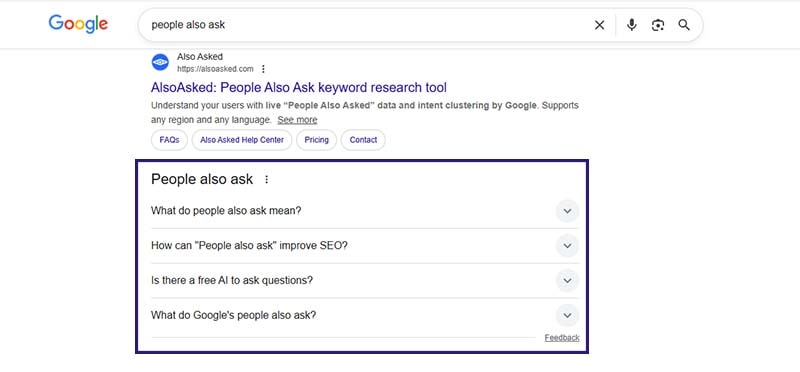
The “People Also Ask” box is an interactive element of Google that displays a list of related questions that users commonly search for. By clicking on any question, a brief answer retrieved from a web page is shown, which is generally a featured snippet–style summary.
PAA boxes:
- Further reveal questions when users click on them
- Being dynamically generated according to semantic relevance
- Get the answers from pages that have concise and well-structured content
- Corresponds to the expansion of the user’s intent, which is a very important feature of Google’s AI-driven SERP experience
Why PAA Optimization Matters
Being featured in PAA boxes enhances your SEO work in a number of ways:
1. Higher SERP Visibility Without Ranking #1
Your content can be visually associated with a query via a PAA box even if the page with your content is not the first one, but is on the second or third page of the results.
2. Increased Topical Authority
Google uses PAA placements as a signal that the source content not only covers but is deep-dived into the topics of a particular cluster.
3. Higher CTR & Brand Exposure
Most users are “accordion-browsing” through PAA answers, i.e., they open one answer after another to check the content without actually clicking through to the website. This way, your brand gets noticed just by being there.
4. Voice Search Optimization
PAA answers serve as a source of information for Google Assistant, voice search, and AI-generated summaries.
How Google Chooses PAA Answers
Google takes into account a few factors while determining the PAA responses:
Concise Answer Format
30–60-word direct answers perform best.
Clear question-aligned headings
Google is mainly dependent on the heavily sectioned:
- H2/H3 in question format
- Exact match PAA keywords
Strong semantic relevance
Google checks if your answer matches:
- The question context
- Related queries
- Conceptual entities
Clean HTML and structured content
Paragraphs, lists, and tables work extremely well together.
How to Rank in People Also Ask Boxes Step-by-Step
1. Find PAA Questions in Your Keyword Cluster
Employ the tools and methods indicated to gather the PAA questions:
Tools
- Google SERP (manual search)
- AnswerThePublic
- AlsoAsked
- Semrush > Keyword Magic Tool > “Questions” filter
- Ahrefs > Keywords Explorer > “Questions” report
Process
- Search your primary keyword in Google.
- Expand 3–4 PAA questions.
- Record all newly generated questions.
- Cluster questions by intent and semantic similarity.
2. Optimize Headers Using Question-Based Formatting
Use H2 or H3 headers that reflect real PAA-style questions.
Examples:
- H2: What is the best way to optimize for PAA?
- H3: How long should a PAA answer be?
- H2: Why do PAA questions expand when clicked?
This creates a direct match for Google’s PAA answer-extraction system.
3. Provide a 30–60 Word Direct Answer (Immediately Under the Header)
Google prefers short, punchy, clear answers.
Template for Answer Paragraphs
[Define or answer the question directly in 30–60 words.]
[Include the primary keyword naturally.]
[Add a semantic keyword or entity to reinforce topical relevance.]Example
Q: How long should PAA answers be?
A PAA answer should stay between 30 and 60 words and clearly address the query in a concise format. Google prefers direct, skimmable responses that match search intent and are easy to extract for rich results.
4. Expand Answers With Supporting Information
After the direct answer, expand your section with:
- Bullet points
- Numbered steps
- Short lists
- Tables
- FAQs
This helps Google understand your page’s depth and coverage.
5. Use Semantic and Entity Optimization
Google surfaces PAA questions based on semantic search, so you must incorporate related entities.
Add Semantic Keywords Like:
- “related questions”
- “search intent”
- “SERP features”
- “featured snippets”
- “long-tail keywords”
- “structured data”
- “search behavior”
- “user intent patterns”
Tools for entity mining:
- Google’s NLP API
- SurferSEO
- Clearscope
- InLinks
6. Use Schema Markup to Support Answer Extraction
Although the schema does not guarantee PAA placement, it increases extractability.
Helpful Schema Types
- FAQPage
- HowTo
- Article
- QAPage
Tip
Avoid spammy FAQ stuffing—only include Q&A that exist in your content.
7. Improve Content Depth and Topical Authority
As your topical authority becomes stronger, your content will be able to answer more PAA questions.
Ways to build coverage:
- Create cluster pages
- Use links to semantically related articles
- Include FAQ sections
- Make under-optimized sections more
8. Optimize for User Intent Behind Each PAA Question
Each query usually matches one of four intents:
- Informational (What, Why, How)
- Navigational (Where to…)
- Commercial (Which is best…)
- Transactional (How to buy…)
Match the format to user expectations:
- Definitions → informational
- Comparisons → commercial
- Steps → transactional
9. Use Clean, Crawlable Content Formatting
Google extracts answers more easily when your content is technically optimized.
Ensure:
- Short paragraphs
- Simple sentence structure
- Clear H2/H3 hierarchy
- Mobile-first formatting
- No hidden or collapsed text
10. Track PAA Performance
Monitor your PAA rankings via:
- Google Search Console
- Semrush > SERP Features tracking
- Ahrefs > SERP Features filter
Track your:
- PAA impressions
- PAA clicks
- Pages ranking for PAA
- Query expansion behavior
Best Practices for PAA Optimization
Use “Question → Answer → Expansion” Structure
Every PAA-targeted section should follow this flow:
- Header in question format
- 30–60-word answer
- Supporting explanation or list
Include Long-Tail Variations
Optimize for long-tail sub-questions such as:
- “Why does [topic] matter?”
- “Is [topic] worth it?”
- “When should you use [topic]?”
Build a Cluster That Answers ALL Related Questions
Winner pages often cover:
- What it is
- Why it matters
- How it works
- Pros and cons
- Steps
- Examples
- Alternatives
Common Mistakes That Prevent PAA Rankings
- Answers that are too long
- Lack of question-based headers
- No semantic coverage
- Irrelevant or shallow content
- Poor page structure
- Missing supporting formats (lists, tables)
- No FAQ, no schema, no clusters