On-page SEO is the process of optimizing individual website pages to improve search engine rankings and user experience. For small business websites, it involves optimizing content, title tags, headings, URLs, internal links, images, and technical elements so search engines can clearly understand the page and rank it higher in relevant search results.
On-page SEO is no longer something small business websites can skip. It is essentially the groundwork that determines either your website will surface on Google or get buried with thousands of other competitors. Even a stunningly designed website with excellent services will face difficulties if search engines are not able to properly understand and rank the site pages.
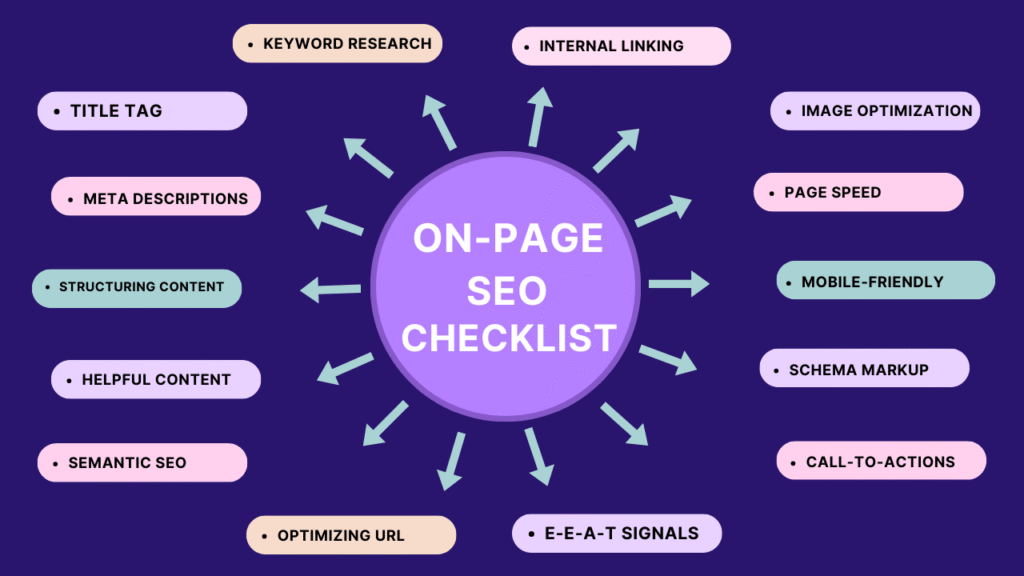
This in-depth guide uncovers the on-page SEO checklist thoroughly for small business websites, emphasizing clarity, usability, and long-term search visibility. Each section is explained in detail enough so that business owners and novices can easily grasp and apply these techniques.
What Is On-Page SEO?
In simple words, on-page SEO means all those optimization moves you make to a page of your site to let search engines know what the page is about, how relevant it is, and how good its quality is. This covers not only the content but also the structure of the pages, site loading speed, and user behavior.
Compared to off-page SEO that relies mostly on backlinks and other external signals, on-page SEO is always within your hands. If you do it well, it will be easier for search engines to understand what your site is about, and thus you get matched with more relevant search queries, plus the users will be happier.
Why On-Page SEO Is Essential for Small Businesses
Small businesses typically face competition from merely large brands that have more substantial domain authority and bigger marketing budgets. On-page SEO gives small businesses a chance to compete by focusing on targeted audiences and different user intent rather than using broad, highly competitive keywords.
A well-SEO-optimized website gets the right kind of visitors, those who are actively searching for your services, which in turn raises the level of engagement, trust, and conversion. The website’s performance SEO-wise will also be better in terms of usability, as visitors will find it easier to navigate the site and take any desired action. If you have weak on-page SEO, you might get visitors to your site, but they won’t turn into leads or customers.
Keyword Research with Search Intent Focus
Keyword research determines the success of on-page SEO. The objective is not to choose the most popular keyword but to find keywords that satisfy the user’s request. Small businesses get the most out of long-tail keywords that specify exactly what the user needs.
Figuring out whether a query is meant to gather information, purchase, or make a transaction gives you an idea of the kind of content you should create to meet the users’ needs directly. Content that perfectly matches the intent is rewarded with the ranking by search engines; also, users spend more time on the page.
Title Tag Optimization for Search Visibility
The title tag is the most powerful ranking factor on-page. It informs the search engines about the topic of your page and at the same time, helps to get more clicks from users. A good title tag should incorporate the main keyword in a natural way and at the same time be readable and attractive.
Small business websites can use title tags to communicate the value and relevance of their offerings very clearly. Over-optimizing or stuffing with keywords might decrease the click-through rate and even break the trust. Both the ranking and the user engagement will get a boost through a clear and benefit-driven title.
Writing Effective Meta Descriptions
Meta descriptions are not a factor that search engines use to pass on rankings, but they do have a huge impact on the number of visitors your page gets. When users are checking the results on Google, the meta description assists them in figuring out whether they will click your page or someone else’s.
A powerful meta description briefly describes the content, contains the keywords in a natural way, and shows the reader why they should keep reading. Small businesses can use this as a tool to lure the right kind of visitors by giving an accurate depiction.
Structuring Content with Proper Headings
Headings are one of the important elements of content readability and SEO results. They guide the website visitors for scanning the page quickly and at the same time help the search engine to understand the content hierarchy. A nicely structured web page uses a single main heading to indicate the theme and the subheadings to group the related supporting information.
If headings are arranged in a logical manner, the text becomes not only easier to read but also more accessible. Benefits include enhancing user experience, decreasing bounce rates, and thus resulting in higher rankings.
Creating High-Quality and Helpful Content
Generally, search engines rank content that is really useful and written for the users first, rather than for the algorithms. The best content will give a complete answer to the question asked, will explain things in the simplest way, and will have a practical value.
In the case of small businesses, content should be aimed at helping the customers with the issues they may be facing. With the help of the clear explanations, the right examples, and the nice, undemanding layout, one can gain the authority and the trust of the readers. Content that lacks depth or originality rarely performs well in search results.
Semantic SEO and Comprehensive Topic Coverage
These days, SEO is less about spelling out the same keyword over and over and more about getting the gist across. Semantic SEO is basically making sure the content reflects the topic well by using related ideas and natural language. This way, search engines get a better idea of the entire context of the page.
Small business sites can become a topical authority by serving content that includes subtopics, related terms, and frequently asked questions. Doing so increases the likelihood of being ranked for a cluster of related searches instead of just one keyword.
Optimizing URL Structure
It is good practice to have your URLs neat, descriptive, and simple to understand. A properly outlined URL serves as a great guide for both users and search engines in understanding what the page is about, even before they visit it.
Short URLs containing the keywords that relate to the web page give a great impression and are more likely to get clicked on. You should stay clear of extra numbers, symbols, or too complicated structures that make the URL less clear and less user-friendly.
Internal Linking for Better Crawlability
Internal linking refers to linking different pages on the same website and basically helps the search engines to understand and index the content easily. Besides, it directs the users to the related information, and therefore, they are spending more time on the website.
In the case of small businesses, internal linking will help service pages that they want to focus on be strong, and the whole site will get the share of the authority given to the service pages. A well-thought-out internal linking strategy not only improves rankings but also makes navigation and user experience smoother.
Image Optimization for SEO and Performance
Images make the website visually appealing, but if not handled properly, they can be the reason for making a website slow. Additionally, search engines use image metadata to get an idea of the visual content.
When images are optimized properly, they will load quickly, become more accessible, and thus, increase the overall quality of the page. When you use descriptive file names along with accurate alternative text, you not only help the search engines to better understand the image context but also increase the chances of image search visibility.
Improving Page Speed and Performance
Website speed has been a confirmed factor for ranking and a major signal for user experience. Pages that load slowly frustrate users and increase bounce rates, which negatively impacts SEO.
It is highly recommended that small businesses optimize their sites by getting rid of unnecessary scripts, compressing the images, and using a reliable host. Websites that are quicker not only keep visitors but also have a better chance of converting them.
Ensuring Mobile-Friendly Design
Apart from Google’s mobile-first indexing, it also assesses the mobile version of a website before the desktop version. Therefore, if a website works poorly on a mobile device, its position in search results will probably drop.
A site that is mobile-friendly works well with different screen sizes without any trouble and offers the user a smooth experience. Easy navigation, large enough text, and a responsive layout are some of the requirements for SEO success today.
Using Schema Markup for Better Understanding
Schema markup plays an important role in helping search engines understand a website’s content more precisely. It uses structured data to illustrate not only a business’s information and services but also various content types.
By using schema, small businesses can upgrade their search results with features such as FAQs, business information, and ratings, etc. This can lead to higher visibility and an increase in clicks.
Conversion-Focused Call-to-Actions
On-page SEO is not just about drawing visitors, but also about leading them towards a goal. Transparent calls-to-action guide users on what steps to take next and transform the site traffic into leads or customers.
A good CTA blends well with the content, is highly relevant, and goes hand-in-hand with the page’s intent. Pages without them, even if they are high-ranking, may still not result in business conversion.
Building Trust with E-E-A-T Signals
Among the factors that search engines utilize for evaluating content quality are Experience, Expertise, Authoritativeness, and Trustworthiness. It is imperative that small business websites provide evidence of their credibility.
Showing business information, author qualifications, customer reviews, and regularly updating the content instills confidence not only in users but also in search engines. Good E-E-A-T indicators lead to better ranking stability over time.
Frequently Asked Questions
Is on-page SEO enough to rank a small business website?
On-page SEO lays the groundwork for ranking success; however, it yields the best results when combined with technical SEO, top-notch content, and authoritative backlinks. Without well-optimized pages, even the best SEO campaigns usually do not bring significant outcomes.
How often should on-page SEO be updated?
In general, on-page SEO needs to be revisited from time to time, especially if there have been changes in search trends, the range of business services, or updates to Google’s algorithm. Keeping content fresh, enhancing internal linking, and updating old information are some ways to help achieve continual ranking and relevance.
Does website design affect on-page SEO?
Absolutely! The visual appearance of a website has a direct bearing on on-page SEO. Elements such as a simple layout, quick page load time, adjustment to mobile devices, and overall good user experience are factors that not only please visitors but also help search engines better assess the quality of a page, thereby resulting in higher rankings.
What is on-page SEO, and why is it important for small businesses?
On-page SEO refers to the changes made directly to web pages to help search engines understand the content and relevance better. In general, on-page SEO is very crucial for small businesses as it not only enhances their visibility and ranking in search engine results but also helps in the generation of targeted traffic and thus, the conversion of visitors into customers, with less dependence on paid advertisements.
How long does on-page SEO take to show results?
Depending on factors such as the size of the website, the competition, and how often a website is crawled, the improvements made in on-page SEO can start to yield results in a few weeks. However, steadily performing optimization and publishing valuable content typically will bring more significant and longer-lasting results within a span of several months.
Can AI and Google understand long-form on-page SEO content?
Indeed, both Google and AI-based search engines are inclined towards long-form, comprehensively structured content that discusses the topics in detail. Semantic enhancement and the use of everyday language are the features that make it simple for AI engines to extract and suggest content.
Wrapping up
On-page SEO is the foundation that small business websites rely on to be digitally successful. It helps search engines to recognize your content, provides users with an excellent experience, and encourages visitors to take positive actions.
Small businesses can raise their rankings, gain more targeted visitors, and create a steady online growth by implementing this comprehensive on-page SEO checklist. The keys to sustainable success are continuous optimization and quality content.