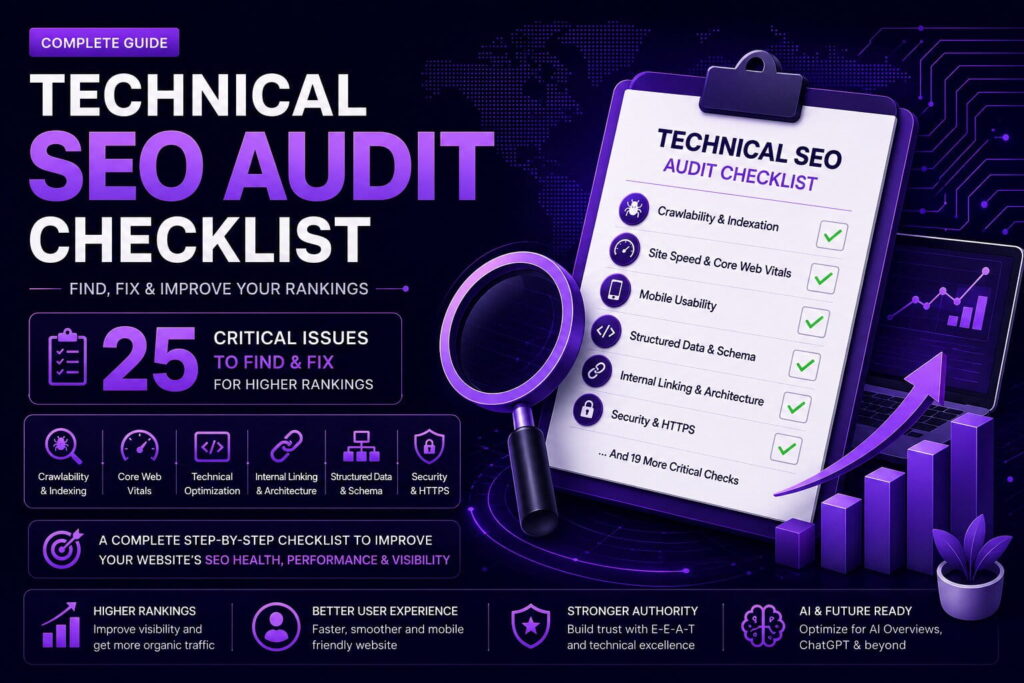
A Technical SEO Audit helps identify and fix website issues that impact crawlability, indexing, page speed, Core Web Vitals, structured data, and search rankings. This complete checklist covers 25 critical technical SEO problems and provides actionable solutions to improve Google visibility and AI search performance.
Technical SEO has changed radically over the last few years. These days, Google ranking factors go way beyond backlinks and keywords. Search engines use very sophisticated crawling systems, machine learning algorithms, semantic understanding, user experience metrics, structured data, and AI-powered retrieval systems to decide which pages deserve to be seen.
Publishing great content, getting quality backlinks, and using important keywords will still not work if there are technical things in the way that keep search engines from properly crawling, rendering, indexing, and understanding your content. In fact, many businesses struggling with organic traffic often discover the same technical issues discussed in our guide on why your website is not ranking on Google.
That’s why a thorough technical SEO audit is still one of the most effective SEO tasks you can do for sites of any size.
Technical SEO is the baseline on which all other SEO efforts rely, whether you run a website for a local business, a SaaS platform, an ecommerce store, a large publication, or a content-oriented blog.
This post provides a Comprehensive Technical SEO Audit Checklist. It covers the top technical issues that affect SEO, how to spot them, how to get them fixed, and how to make your website ready for Google Search, AI Overviews, ChatGPT-based discovery systems, Perplexity AI, and other AI search experiences of the future.
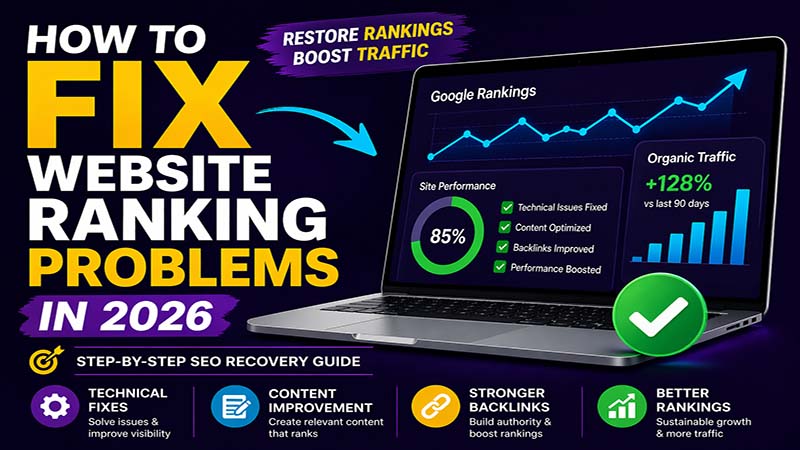
If your website has recently experienced a drop in rankings, this checklist can help uncover hidden technical barriers and support your strategy for fixing website ranking problems before they affect long-term organic growth.
Why Technical SEO Matters More Than Ever
Search engines can now go far beyond simply recognizing the keywords.
Today, modern ranking algorithms are capable of making sense of quite complex factors like the presence of entities and their relationships, interpreting the users’ intent or the site architecture, analyzing the signals of the page experience, working with structured data, and the authority of topics.
Besides that, AI-driven search experiences like Google’s AI Overviews are totally changing the way new information is found and presented to users.
So, what this means is that your website needs to be good enough in both traditional ranking and AI retrieval systems.
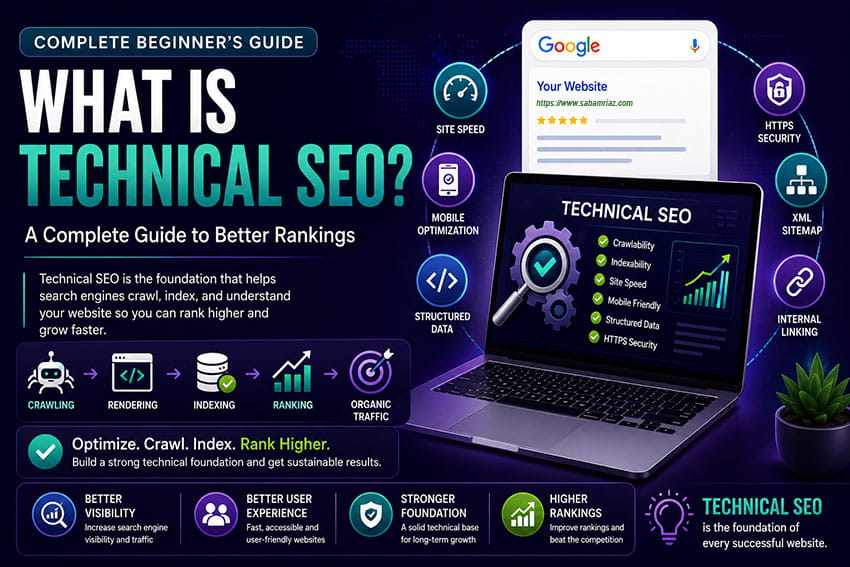
Technical SEO is the way to do that because it focuses on making content more accessible, clear, and reliable.
If there are technical problems, the search engines might:
- Not be able to find new pages, or even discover old ones
- Be unable to render the content as intended
- Have problems with figuring out the relationships between pages
- Process structured data
- Allocate crawl resources efficiently
- Evaluate user experience signals
It is not unusual in quite a few technical SEO audits that the root cause of ranking issues will be infrastructural, rather than the quality of the content.
Sorting out these problems will provide the base on which the organic growth can be sustained, quite strongly.
The Complete Technical SEO Audit Framework
Before diving into specific technical problems, it is vital to first figure out the way professional SEO teams do a technical audit. If you’re looking for a broader framework that covers technical, on-page, and off-page optimization, our SEO Audit Guide for Websites provides a complete website audit process.
Successful audits usually go through five main stages.
Phase 1: Crawlability Analysis
Initially, the primary goal is to check if search engines are capable of accessing the key content of the website. This phase looks into robots.txt directives, XML sitemaps, internal linking, and navigation systems, as well as crawl paths and the distribution of crawl budget.
It is necessary to note that if search engines are not able to crawl the content very well, then the ways of ranking become restricted.
Phase 2: Indexation Analysis
The next step is to find out whether the key pages are really being indexed by search engines.
In this phase, issues related to canonical tags, duplicate content, index coverage reports, parameter URLs, pagination systems, as well as noindex directives, are checked.
Phase 3: Performance Analysis
Performance is one of the key factors that not only impacts user engagement but also influences rankings.
During this step, we review things like Core Web Vitals, page speed, server responsiveness, use of optimized images, mobile friendliness & resource saving.
Phase 4: Structured Data Analysis
Structured data makes it easier for search engines to accurately capture what the page content is all about.
We will assess here if the schema markup is done properly and check if the site is eligible for rich results, how effectively the site associates with entities, and generally how it structures content in a way that the machines can read.
Phase 5: AI Search Readiness
To sum up, the fifth and last phase of the process can be described as assessing the website’s capability to interact with the AI-driven search experience.
This includes semantic optimization, entity SEO, knowledge graph alignment, content hierarchy, and information architecture.
While the framework in this guide applies to websites of all sizes, small business owners may also benefit from our Technical SEO Checklist for Small Business Websites, which focuses on practical technical improvements that can be implemented without an enterprise-level SEO team.
Technical SEO Audit Checklist: 25 Critical Issues to Fix
1. Indexation Problems
Indexing is still considered the most crucial part of technical SEO since pages that are left out of the index have no chance to rank.
One of the main issues found during technical SEO audits is the fact that some valuable pages might never surface in search results just because they’re not getting indexed properly. Most website owners think that Google will automatically index every page, but the reality is quite different.
There are many reasons why some pages may not get indexed. They include issues like poor internal linking, duplicate content, crawl restrictions, low content quality, accidental noindex directives, and canonicalization errors.
To detect indexation issues, the best thing to do is to check your XML sitemap vs. the indexed pages that Google Search Console reports. Don’t forget to review your commercial pages, service pages, category pages, and cornerstone content most thoroughly.
Rather large differences between submitted and indexed URLs often mean that there is some sort of problem hiding beneath the surface.
Indexation has been the main driver of very large organic traffic increases in a number of enterprise SEO projects because it made contents that were previously invisible to search engines available for ranking.
While resolving indexation problems, it is essential to make the site more crawlable, build stronger internal link structures, eliminate duplicate content, and make sure that every important page has its own unique value.
2. Robots.txt Configuration Errors
With the robots.txt file, you basically tell search engine crawlers what to do.
The file is quite straightforward. However, making errors in it can lead to extremely bad results.
Besides that, one slipped-in instruction might block search engines from crawling a whole website.
The most frequent problem is when a site redesign or migration happens, and the restrictions on the development stage are still “live” after the launch. In such a case, several important pages may be blocked from crawling without the website owner even knowing it.
When you perform a technical SEO audit, go through all robots.txt directives one by one very attentively.
You should also double-check that the most essential parts of the website are accessible by search engines while disallowing, for example, the admin panels, temporary files, and internal search pages, which are usually the ones you want to hide.
Besides that, it’s crucial to verify that the robot is allowed to fetch the JavaScript, CSS, and images, which are needed for proper rendering.
Google is slowly shifting to judging websites by visually rendered content rather than by the raw HTML only. So, if you deny the crawling of vital resources, it will definitely have a negative effect on how search engines understand your content.
With the help of a well-tuned robots.txt file, you not only make the crawl more efficient but at the same time you also ensure that the search engines have access to all the content that is able to rank.
3. XML Sitemap Issues
When done right, XML sitemaps continue to be a technical SEO tool of great value.
They assist in increasing the exposure of the most important pages to search engines, help search engines understand how a website is structured, and allow them to plan their crawling accordingly.
Still, many sites have very badly optimized sitemaps.
In fact, it is not a rarity to see XML sitemaps with URLs that lead to redirects, 404 pages, duplicates, parameter-based URLs, and pages that are no longer indexed during audits.
Such matters not only lessen the effectiveness of a sitemap but also cause undue perplexity to search engines.
An excellent XML sitemap is one that has only canonical, indexable URLs that add unique value.
Each URL in the list should be a piece of content that is warranted by the logic of visibility in the search results.
In case of a huge website, segmentation of the sitemap might be an advantageous step for both management and monitoring. To create separate sitemaps for blogs, products, categories, videos, and images is a common way to organize and clarify better.
Keeping a sitemap routinely up-to-date enables search engines to give more attention to the more essential pages.
4. Crawl Budget Waste
Crawl budget is the measure of how much time and resources search engines decide to spend on a website while crawling it.
However, for very small sites, the potential impact of crawl budget is minimal, but there comes a point past which size makes the importance of crawl budget more and more.
What’s more, mechanisms to produce multiple URLs such as filters, search parameters, pagination, and dynamic content could lead to a giant number of URLs for large e-commerce stores, news publishers, and enterprise websites.
On the other hand, if search engines invest a lot of their resources in crawling less valuable URLs, they simply might not have enough time for the more important pages.
As a result, indexation might be delayed, the discovery of content will be severely limited, and overall efficiency across the website will be lost.
It’s a common scenario that introducing crawl budget issues during technical SEO audits is mainly detected in websites with features like faceted navigation and a high number of uncontrolled URL parameters.
Minimizing crawl waste is, in most cases, done through a combination of identifying and redirecting or removing duplicate URLs, improving internal linking, setting up proper canonical tags, and disallowing unnecessary crawling paths.
Crawl budget management is mainly geared towards ensuring that search engines give priority to the most valuable content rather than the less important pages.
5. Duplicate Content Problems
Duplicate content keeps being one of the hardest SEO issues that people misunderstand.
It is a common misconception that duplicate content can lead to a direct penalty. Actually, it may have a strong negative impact on rankings if it creates confusion among search engines.
If the same or very similar content is present on multiple pages, the search engines will have to choose which one to show in the results.
This easily leads to authority dilution, problems with indexing, and irregular visibility.
Common sources of duplicate content are URL parameters, category hierarchies, ecommerce filters, HTTP and HTTPS versions, printer-friendly pages, and syndicated content.
Conducting a technical SEO audit will help you catch the exact duplicates, as well as the near-duplicates.
The currently preferred SEO methods are geared towards merging the ranking factors by using canonical tags, redirects, content differentiation, and site structure.
Getting rid of duplication is one of the ways to help search engines understand the site better and have more potent signals on the whole website.
6. Canonical Tag Errors
Search engines mainly use canonical tags to figure out what the main version of a page is.
If you do it right, it will help you solve duplication problems and put all your authority signals together.
On the other hand, canonical errors can be found in large amounts of technical SEO problems during audits.
For instance, self-referencing canonicals pointing incorrectly, category pages being canonicalized to unrelated URLs, canonical chains, and conflicts between canonicals and redirects.
This kind of stuff would definitely mess with search engines and make these important pages unable to rank properly.
In most cases, each indexable page should have a canonical tag that points to itself unless there really is a reason to select another URL as the preferred version.
It is very important to keep the canonical tags, XML sitemaps, redirects, and internal links consistent with each other.
When all these signals are consistent, search engines can interpret the content with less doubt and are able to appropriately distribute the ranking authority.
7. HTTPS and Website Security Issues
Security signals have become one of the main components for earning users’ as well as search engines’ trust.
In fact, HTTPS is almost everywhere nowadays, while a lot of websites are still exhibit security-related technical weaknesses that, among other aspects, influence their online performance and the trust that users place in them.
Many of these vulnerabilities stem from weak website security practices. If you use WordPress, our WordPress Security Basics guide covers the essential steps needed to secure your website and reduce common security risks.
By the way, search engines give precedence to a secure browsing experience since it is a major factor in gaining end users’ trust.
Therefore, it is a good idea that a technical audit uses secure loading to measure every page and consistency checks of HTTP versions being redirected to HTTPS ones.
More than usual, attention should be paid to images, scripts, stylesheets, and third-party resources that may still be loading through insecure connections.
Proper technical security is not only a driver for SEO but also leads to increased user trust and higher conversions.
8. Core Web Vitals Failures
Core Web Vitals is still one of the top ranking factors based on performance.
These metrics are all about how users really feel when they visit a website.
At the moment, Google is measuring:
Largest Contentful Paint (LCP) for loading time.
Interaction to Next Paint (INP) for responsiveness.
Cumulative Layout Shift (CLS) for visual stability.
Failing to meet Core Web Vitals targets does not simply mean bad user experience; such a scenario often points to deeper technical problems.
Problems like unoptimized code, very large media files, resources that block the rendering process, slow hosting infrastructures, or use of numerous third-party scripts.
It is not uncommon that focusing on Core Web Vitals upgrades during technical audits reveals that there is more to that than just SEO benefits.
What’s more, there is the user perspective who enjoys faster website load time, more fluid interaction, lower bounce rate, higher engagement…
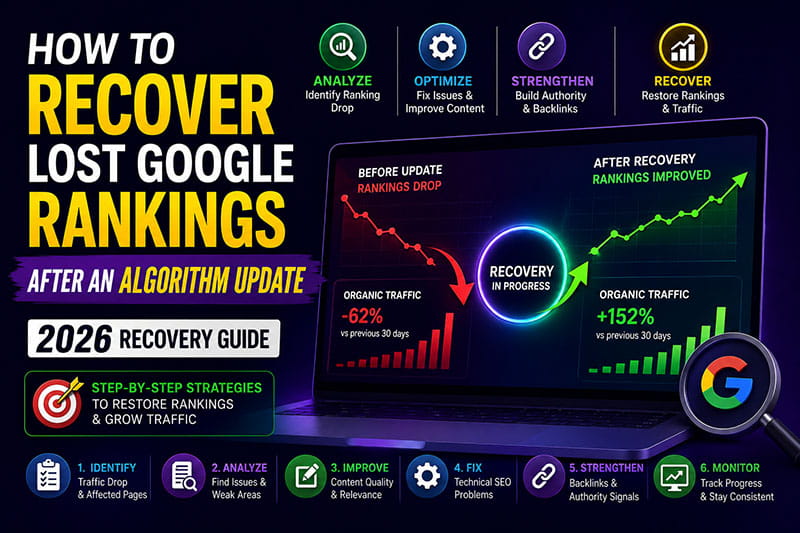
When it comes to competitive industries, strong Core Web Vitals performance can be the difference between losing visibility and outranking slower competitors. For websites that have already seen traffic drops, improving these metrics is often one of the first steps in learning how to recover lost Google rankings after an algorithm update.
9. Mobile Usability Issues
Mobile-first indexing isn’t a fresh idea anymore, but the reality is that a lot of websites are still missing out on giving their visitors a great mobile experience.
Google mainly looks at the mobile version of a site when figuring out rankings and how it should be indexed. So, even if your desktop site is perfect, your rank can drop if mobile users face issues using the site.
Some typical mobile usability issues uncovered during technical SEO inspections are: very small text, unusually tiny buttons that can’t be accurately tapped, pop-ups that cover most of the screen content, errors related to the viewport setting, and designs that don’t work well on smaller screens.
Frequently, webmasters put a lot of effort into the desktop version and completely ignore the fact that the main mode of interaction for most users is the smartphone.
A proper mobile experience should be centered around ensuring that text is easily readable, the site is accessible, and navigation is so simple that users do their thing with no hitches. Pages must load fast, content should stay easily viewable without users having to zoom a lot, and things like buttons and menus should be the same across all devices.
Google is putting more and more emphasis on actual user experience in the real world, which means enhancing mobile usability is not just about meeting requirements but also about designing a space that people want to visit and get engaged with.
If you want to assess the mobile performance of a site, don’t just take a quick look at the homepage or a couple of the main pages. Instead, you should individually check out each major page template.
Groups of pages that are visually and functionally similar can usually be treated as a single template for this type of analysis.
A site that scores high in delivering an excellent mobile experience is expected to have a comparatively higher chance of securing a top spot in the search results, both PGs and AI-based search results.
10. Site Speed Optimization Problems
Website speed is still a very strong signal of technical quality on the whole.
People want websites to load really fast these days. A 1-second delay is already enough for people to leave, especially if they are browsing on their phones.
Often, technical audits uncover site speed problems which are mostly a result of unoptimized images, too much JavaScript execution, oversized CSS files, slow hosting infrastructure, inefficient caching settings, and even the use of unnecessary third-party resources.
Even though site speed primarily affects the user’s experience, it also has an impact on how search engines distribute their crawl resources.
Very slow websites might make it less possible for search engine bots to crawl a site efficiently. In other words, the bots spend more time processing each page.
Speed improvements should be pursued after the performance bottlenecks are located.
Here is what you can do: check if server response times are okay, see if there are any resources blocking the rendering of your page, resize your images, enable browser caching, get rid of unnecessary scripts, and use content delivery networks where needed.
Eliminating features which hardly add any value yet consume a great deal of resources is the most ignored part of speed optimization in many cases.
You can expect a lot of positive outcomes such as boosted SEO rankings, enhanced user experience, increased conversion rates, and improved overall business performance when your website runs faster.
11. JavaScript SEO Issues
Most Modern websites today depend heavily on JavaScript frameworks to offer users a more interactive and engaging experience.
Though nowadays search engines have greatly enhanced their capability to render JavaScript content, there are still technical issues enough to cause concerns.
In fact, the majority of websites are inadvertently concealing their important parts such as primary content, internal links, titles, meta descriptions, structured data, and navigation systems behind the rendering procedures of JavaScript, which are not always comprehensible to search engines.
In the process of performing technical SEO audits, we often find that JavaScript causes issues, especially when the content is visibly right to users but is still out of crawler’s reach.
This mismatch can result in problems with indexing, a drop in visibility, and an incomplete picture of the website in the search engine’s mind.
Initially, check that all the essential components of your pages are present in the rendered HTML.
The important elements such as main content, internal linking, page titles, meta descriptions, structured data, and navigation systems must be accessible for the search engines without going through an extremely complex rendering process.
Those who develop websites with JavaScript frameworks React, Angular, Vue, etc., should take a look at various server-side rendering strategies and the hydration step.
Besides, as search engines give more weight to how accessible the content is and the overall user experience, JavaScript SEO continues to be one of the major technical factors for contemporary websites.
12. Structured Data Implementation Errors
Search engines are made aware of what the contents of a website are through structured data.
Schema markup allows for the transmission of machine-readable data, which enables support for features such as rich results, entity detection, knowledge graph linking, and AI-assisted search functionalities.
Sadly, there are still many sites that either do not have structured data or implement it incorrectly.
Some typical results of the site audit are: missing properties that are required, the use of schema types that are invalid, the supply of wrong data, the production of duplicate markup, and the sending of conflicting entity signals.
Any of these mistakes can severely restrict the ability of the search engines to understand the content correctly.
The proper way to implement structured data is by not only using it.
Schema markup is a great way to provide an accurate description of the content on each individual page while at the same time being a means of helping the achievement of broader overall website objectives.
As an illustration, article pages should make attributions such as authors, publication dates, and organizations. On product pages, pricing and availability information will be prominent. Local business pages will share their neighborhoods and locations with their visitors.
Structured data with AI search is an ever-more vital part of machine interpretation and finding content.
13. Internal Linking Weaknesses
Website owners often overlook internal linking as one of the biggest SEO opportunities.
Many website owners are very focused on backlinks and overlook that the authority is also flowing internally in the website.
Search engines use internal links to find the content of the website, understand the relationships between topics, and spot the key pages.
Poor internal linking structures typically lead to highly valuable content getting a low amount of visibility.
A technical SEO audit will often reveal outlook pieces that have been pushed so far down the page hierarchy and have very few internal references.
One of the objectives of an internal linking strategy is to connect logically through paths related topics as well as the distribution of authority.
With the addition of links, it is better to make a semantic connection because that is the one that will strengthen the topical expertise.
A technical SEO guide, for example, should be linking to resources connected to site architecture, structured data, crawl budget optimization, and Core Web Vitals.
Excellent internal linking simultaneously leads to better crawlability, indexation, user engagement, and semantic relevance.
14. Orphan Pages
Orphan Pages are pages that are present on your website but have no internal links from other pages.
As search engines mainly find new content through links, orphan pages mostly have issues with getting noticed.
In fact, even when orphan pages are listed in XML sitemaps, they usually get less crawl attention compared to the pages which are part of the navigation and content structure of the site.
If you are a technical auditor, you will find orphan pages mostly after website redesigns, content migrations, category changes, or publishing workflow inconsistencies.
It is not uncommon for website owners to be shocked at discovering that they have hundreds of valuable pages which are, in fact, quite isolated from the rest of the website.
All you need is to find orphan content and add it to the site’s internal linking system.
Any page that you consider important should have a path via the logical navigation.
Good website architecture helps both users and search engines find the content in a natural way rather than depending completely on XML sitemaps.
Making fewer orphan pages leads to better crawl efficiency, authority distribution, and ranking potential.
15. Poor URL Structure
The layout of URLs affects both the experience of users and search engines’ perception of the website.
In fact, URLs don’t rank among the strongest ranking factors. However, bad URL design often leads to larger technical and organizational issues indirectly.
Usually, websites end up with very long and complicated URLs filled with unnecessary parameters, session IDs, date, or unrelated hierarchical levels of folders.
URLs like this are hard not only to understand but also to share and manage.
Ideally, a URL that is well-optimized can still be concise and descriptive but at the same time clearly show what the page is about.
Having URLs that make sense also supports the website structure by giving search engines clues about the connections between content.
So, category pages, service pages, and content made for knowledge-sharing, for instance, should have uniform patterns that show where they are located within the whole site hierarchy.
URL enhancement is a common source of crawling efficiency, duplication removal, and information architecture improvement that gets revealed from the technical SEO assessments.
If anything, URL changes should only be done after careful consideration. But thoughtfully made improvements can still lead to uncovering a less complicated and more expandable site structure.
16. Redirect Chains and Redirect Loops
If URLs change, redirects are definitely the way to go in order to keep SEO value intact.
Unfortunately, many times badly implemented redirects cause technical issues, which badly affect users and search engines.
A redirect chain is basically a situation when one URL leads to another URL, which then leads to another, before the final page destination is reached.
Every new redirect slows things down and is more inefficient.
Redirect loops are even more problematic as they get both visitors and bots stuck in endless redirect circles.
Essentially, these mistakes make it impossible to get to the content.
Redirect issues are a common finding of technical audits, especially after migrations, major content changes, CMS upgrades, or URL standardization.
The best redirect setup is the one that immediately takes both people and search engines to the final target location with just one click.
Keeping redirects in a clean and well-ordered state will lead to better crawl efficiency, signal preservation, and a great user experience.
Doing redirect audits regularly is recommended for every SEO maintenance plan that is meant to last for a long time.
17. Weak Site Architecture
Website architecture is the blueprint of your website that not only outlines how your content will be arranged, connected, and found, but also helps your visitors discover the information they are looking for.
At times, even highly efficient SEO experts who are entirely focused on present and future trends of search are so immersed in keywords and backlinks that they forget to pay attention to the structure that underlies them.
If your website is organized in a haphazard manner, then it may end up confusing both users and search engines.
If we look at the symptoms of a weak or improper website architecture during a technical SEO audit, we can find deep page hierarchies, isolated content silos, inconsistent navigation systems, and excessive click depth casually scattered across the website, which reflects poorly on the same.
It is a clear sign that your most valuable pages are not ones that are hidden several levels deep within your website.
In fact, Search engines rely on site architecture not only to interpret content relationships but also to determine topical authority. Besides, a well-thought-out structure is key to the task of linking pages so that they can share their authority with one another, and at the same time, it greatly simplifies the discovery of the most important pages by crawlers.
One of the best tactics is to create topic clusters in which the supporting content is linked in a natural way to the cornerstone pages.
For instance, a technical SEO hub could consist of a page that links to other pieces of content related to optimizing crawl budget, implementing structured data, improving Core Web Vitals, and enhancing site architecture.
Besides their appeal, well-structured websites usually enjoy more efficient crawling, greater user engagement, and enhanced semantic understanding.
18. Image SEO Problems
Images play a crucial role in enhancing the user experience as well as boosting the technical performance.
In fact, among all SEO areas, image optimization is probably the most the least treated one.
One of the consequences of not optimizing images is saving them in large sizes; this often causes pages to load slower, resulting in a negative impact on Core Web Vitals as well as the engagement of users.
During a technical audit, it is not unusual to find that images are excessively large, lack alt text, are in obsolete formats, are named inconsistently, or that the methods for delivering them are not suitable.
The current norm for websites is to focus on compressing images, using responsive image techniques, lazy loading, as well as next-generation formats like WebP.
Despite being overshadowed by other SEO factors, the alt attribute still plays an important role, as they provide not only accessibility to individuals with disabilities but also understanding from search engines regarding the content of the images.
Image optimization can hardly be considered only one of the activities targeted at making a website load faster, providing visually impaired users with better access, and increasing the ranking of a site in the search results.
In case the visual content accounts for most of a site, applying image SEO methods can result in substantial new organic traffic.
19. Broken Internal Links
Broken internal links frustrate users and mess up search engine recognition.
Every broken link is a route that no longer works like it’s supposed to.
Besides decreasing crawl efficiency, broken internal links to search engines disrupt authority distribution.
Users who find broken pages may lose their confidence in the site and simply give up on it.
Content deletions, URL restructurings, website launches, and CMS changes are some of the reasons for broken links that technical audits may reveal.
Leaving such problems can negatively affect crawlability and user experience in the long run.
Periodic link audits are a good idea to keep the internal linking landscape healthy.
Every main internal link needs to be pointing users and crawlers toward accessible, relevant content.
If all the pathways are not functioning properly, then the strength of an internal linking structure will be of no use.
20. Pagination Issues
Pagination is still one of the core technical aspects to be kept in mind by super-large e-commerce websites, huge blogs, directories, and content archives.
Technical errors in pagination can lead to duplicate content issues, spreading of ranking signals, and limited crawl capacity of the website.
Many sites come up with a great number of paginated URLs but do not clearly establish their contextual relations amongst the pages.
Hence, search engines might not be able to figure out how the paginated content relates to the overall structure of the website.
A technical review should determine whether paginated content is still accessible, crawlable, and logically linked.
Category pages should clearly link to more in-depth content while not negatively affecting user experience.
Good pagination methods help with both content discovery and crawl efficiency.
For gigantic sites boasting thousands of products or articles, optimization of pagination can be a deciding factor in the quality of indexation.
21. Log File Analysis
One of the most reliable ways to understand how search engines view a website is through analyzing log files.
In contrast to SEO tools that can only predict crawler behavior, log files present a clear picture of actual actions taken.
Technical SEO experts perform log file analysis to discover issues such as crawl waste, indexing delays, ignored content areas, and server performance problems.
This information is very useful in providing answers to important questions.
Which pages get crawled by search engines the most?
Which pages are hardly crawled at all?
In what areas are search engines wasting their resources?
Do server errors reduce the effectiveness of crawling?
Log file analysis has huge potential for enterprise-level websites, where even minor crawl inefficiencies can affect a large number of URLs.
Companies aiming at gaining top-tier technical SEO insights should include log analysis as an essential part of their audit process.
22. Hreflang Implementation Errors
International websites have to deal with some very specific technical SEO difficulties.
For example, when there are several language or regional versions of the same content, search engines need extra hints to figure out which version should be displayed to various audiences.
Hreflang tags are one of these hints.
Yet, it is not rare for technical audits to reveal various hreflang problems such as missing return tags, incorrect language codes, broken references, and conflicting canonical tags.
Such mistakes may cause duplication of content issues, unstable rankings, and users’ dissatisfaction with the websites.
A correctly set up hreflang system will make sure that people get to see the language and regional variation of content which are the most appropriate for them.
For multinational brands, accurate implementation of hreflang is still a must for international SEO success.
23. AI Search Readiness Problems
A major update to technical SEO is the readiness of AI search.
The presence of generative AI is growing in the ways search is done by search engines.
AI Overviews, conversational search, and answer engines are based on the use of structured data, semantic clarity, and entity relationships.
However, most sites keep optimizing only traditional ranking factors, and they continue to miss how AI systems retrieve information.
Performing a technical SEO audit is a good habit to understand if content is structured in a way that facilitates machine comprehension.
Factors to review would be the content hierarchy, schema markup, entity consistency, semantic relationships, and information accessibility.
Sites that implement AI retrieval optimization techniques enjoy a higher rate of showing up in the results of AI-generated answers and conversational search.
Since AI search becomes more prevalent in the market, technical SEO has to expand its scope beyond the typical crawling and indexing only.
24. Entity SEO Gaps
Search engines are getting better at identifying the web through entities instead of only keywords.
An entity is a person, business, product, place, organization, idea, or topic.
Entity SEO is all about showing search engines the connections of these entities.
One of the common reasons why weak entity signals get detected in technical audits is the use of different terms for the same thing, lack of structured data, poor topic linking, and disorganized content layout.
By doing entity optimization well, you can strengthen your topical authority and make it easier for the search engines to find related info throughout your website.
To illustrate, a site about technical SEO should always show the relations of crawlability, indexing, structured data, Core Web Vitals, site architecture, and semantic optimization.
Once these links are strong, search engines and AI systems will more easily recognize the expertise in the given subject matter.
It is quite likely that entity SEO will be a major factor in the upcoming changes of search algorithms.
25. Weak E-E-A-T Technical Signals
Experience, Expertise, Authoritativeness, and Trustworthiness still play a major role in the way search engines assess the quality of the content.
Even though E-E-A-T is mainly spoken about as a content idea, technical SEO can help indicate these signals in a few important ways.
A technical review should check that there is author information that is clear, organization information, contact pages, privacy policies, security features, structured data, and transparent website ownership information.
Search engines look for proof that the content is made by a credible source.
Technical trust signals contribute to strengthening this credibility.
Actually, sites with top-notch content and strong technical trust signals quite often get to the higher ranks in the highly competitive search environment.
With AI systems coming more and more to the rescue in reliably evaluating sources, technical E-E-A-T optimization is turning out to be even a greater priority.
Technical SEO Audit Priority Matrix
Not all issues deserve equal attention.
The following framework helps prioritize fixes.
| Technical Issue | Priority Level | SEO Impact |
|---|---|---|
| Indexation Errors | Critical | Very High |
| Robots.txt Problems | Critical | Very High |
| XML Sitemap Issues | Critical | Very High |
| Core Web Vitals Failures | High | High |
| Mobile Usability Issues | High | High |
| Canonical Errors | High | High |
| Duplicate Content | High | High |
| Structured Data Errors | Medium | Medium-High |
| Internal Linking Problems | Medium | Medium-High |
| Image Optimization | Medium | Medium |
| Redirect Chains | Medium | Medium |
| Hreflang Issues | Medium | Medium |
| AI Search Readiness | High | Increasingly High |
Best Technical SEO Tools
A complete technical audit requires multiple tools.
Free Tools
- Google Search Console
- Google Analytics 4
- Google PageSpeed Insights
- Google Lighthouse
- Rich Results Test
- Robots.txt Tester
Professional SEO Tools
- Screaming Frog SEO Spider
- Ahrefs Site Audit
- Semrush Site Audit
- Sitebulb
- JetOctopus
- Oncrawl
Enterprise-Level Solutions
- Botify
- Deepcrawl
- Splunk
- Datadog
- Cloudflare Analytics
Using multiple tools provides a more complete understanding of website health.
Technical SEO for AI Overviews, ChatGPT, and LLM Search
SEO is not just about traditional rankings anymore.
Modern AI systems use a different approach to retrieving information than classical search algorithms.
To enhance visibility in an AI-based search scenario, websites need to:
Strong Entity Signals
Introduce entities such as people, organizations, products, services, and topics unambiguously throughout the website.
Semantic Content Relationships
Establish meaningful linkages between related content.
Structured Data Implementation
Make it easier for machines to interpret content correctly.
Topical Authority
Consistently develop topics and do not just release one-off pieces of information.
Clear Information Architecture
Make sure that the information is arranged logically and uniformly.
Only those websites which pair technical excellence with semantic optimization stand a chance of being showcased in AI-produced answers.
Most Common Technical SEO Mistakes
Even experienced website owners make recurring mistakes.
The most common issues include:
- Blocking important pages in robots.txt
- Incorrect canonical implementation
- Ignoring Core Web Vitals
- Creating excessive URL parameters
- Publishing duplicate content
- Neglecting structured data
- Weak internal linking
- Ignoring orphan pages
- Failing to optimize for mobile users
- Overlooking AI search readiness
Avoiding these mistakes alone can significantly improve website performance.
The Future of Technical SEO Beyond
Technical SEO is evolving toward machine-readable web architecture.
Future search systems will increasingly rely on:
- Entity-based indexing
- Knowledge graph relationships
- Semantic understanding
- AI retrieval systems
- Structured information
- Real-time content processing
- User experience signals
The websites that succeed in the coming years will be those that combine traditional SEO fundamentals with advanced semantic optimization and AI readiness.
Technical SEO is no longer simply about helping search engines crawl websites.
It is about helping machines understand information.
Frequently Asked Questions
How often should I perform a technical SEO audit?
Generally, a technical SEO audit should be done for a website in its entirety every three to six months. A large website might need to be monitored monthly.
What is the most important technical SEO factor?
Indexation is generally considered the most critical factor because pages that are not indexed cannot rank.
Can technical SEO improve rankings without creating new content?
Indeed. Rectifying technical problems usually enhances visibility because it facilitates search engines in crawling, indexing, and comprehending the existing content more fully.
Is technical SEO more important than backlinks?
Both are very important. However, if technical problems are present and prevent search engines from accessing or understanding the content, then backlinks provide limited value.
Do small websites need technical SEO audits?
Of course. Even small websites can suffer from big losses in their rankings because of technical mistakes.
How does technical SEO affect AI Overviews?
Technical SEO aids in machine comprehension through the implementation of structured data, entity optimization, semantic organization, and the accessibility of crawlers, all of which are fundamental to AI-based retrieval systems.
Wrapping up
Technical SEO remains the foundation of sustainable organic growth in 2026. While technical excellence ensures that search engines and AI systems can access, understand, and trust your information, it should work alongside strong content optimization. For small businesses, combining technical improvements with an effective On-Page SEO Checklist for Small Business Websites can create a stronger foundation for long-term rankings.
By systematically auditing and fixing these 25 critical issues, website owners can improve crawlability, indexation, performance, user experience, semantic relevance, and AI search visibility.
The future belongs to websites that combine Technical SEO + Semantic SEO + Entity SEO + E-E-A-T + AI Search Optimization into a unified strategy. This approach not only improves rankings today but also prepares websites for the next generation of search experiences.