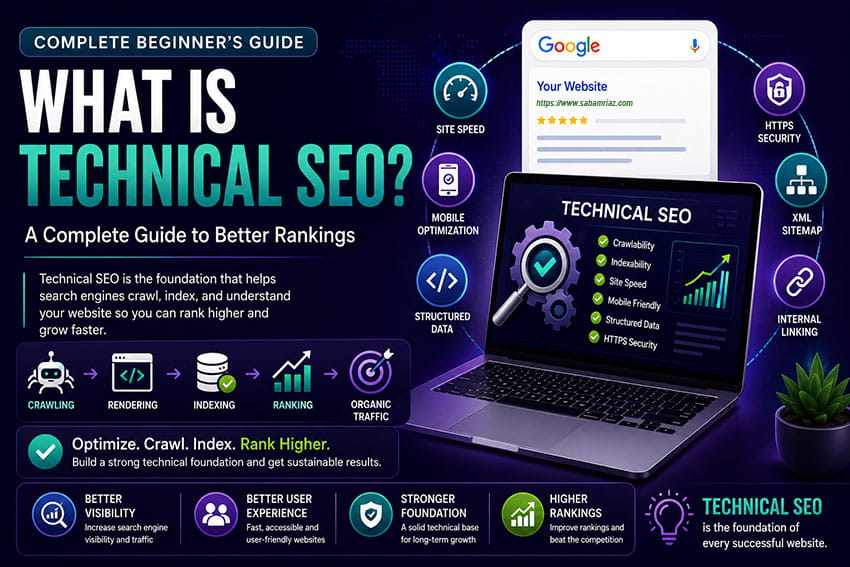
Technical SEO is the practice of optimizing a website’s infrastructure to help search engines crawl, render, index, and rank content efficiently. It includes website speed optimization, mobile usability, XML sitemaps, robots.txt management, structured data, HTTPS security, internal linking, Core Web Vitals, and other technical factors that improve search visibility.
What Is Technical SEO?
Technical SEO involves enhancing a website’s underlying technical elements to allow search engines to efficiently crawl, render, index, and rank pages. This method prioritizes boosting website loading speed, user-friendliness, security, and architecture to assist search engines in comprehending the content more accurately.
While content-centric SEO methods mainly identify relevant keywords and understand searcher intent, Technical SEO guarantees the accessibility and processing of your content by search engines. No matter how great your content is, it may not rank well if technical complications prevent search engines from locating or interpreting it. If you’re looking for a practical step-by-step approach, explore our Technical SEO Checklist to ensure your website follows the essential technical SEO best practices.
Nowadays, technical SEO doesn’t just help with regular search rankings but also with AI-augmented search results. Nowadays, search engines increasingly base their decisions on factors such as website structure, page experience, the semantic relationships among entities, and technical signals to determine which content should receive the most visibility.
For newcomers, Technical SEO might seem daunting at first, but in essence, it’s about making your website simple to be navigated by both search engines and users. If you’re just starting your SEO journey and want to understand how Technical SEO fits into the bigger picture, begin with our SEO for Beginners guide before exploring more advanced optimization techniques.
Why You Can Trust This Guide
Technical SEO is probably the least understood aspect of search engine optimization. Many beginners focus entirely on content creation and backlinks while overlooking the technical foundation that allows search engines to discover and understand that content.
The tutorial uses recent SEO best practices, latest search engine guidelines, and principles of optimization that SEO professionals implement in the real world. It covers concepts of Technical SEO, which are still a major part of traditional Google rankings, and also it looks at newer AI-powered search systems, which are very dependent on structured information and accessibility of the website.
Instead of focusing on old tactics, this guide talks about technical aspects that really affect visibility, user experience, crawl efficiency, and long-term organic growth.
Why Technical SEO Matters More Than Ever
Many website owners think that if they write quality content, then they will rank on Google by default. Actually, content quality is very important but, it is just one component of a comprehensive SEO strategy. A content piece has to be discovered by search engines, then crawled, processed, understood, and finally stored in their index before it is able to show up in search results. Technical SEO aids each step of this process.
You could have the best-written article on a certain topic, but if Google cannot reach the page due to, for example, a crawl error, an indexing issue, or a problem with the website’s structure, then your content will not matter at all since search engines will not be able to properly assess it. If you’re experiencing these or other visibility issues, read our Why Your Website Is Not Ranking on Google guide to learn the most common causes and how to fix them.
Technical SEO makes sure that search engines can quickly access the content on a website. It also ensures that the users receive fast, secure, and mobile-friendly experience. User experience aspects are the signals that a user sends to Google through their interaction with the website, and the better the user experience that a website offers, the better the user will interact, and the more time they will spend on the website, etc. Hence, user experience has a significant impact on the rankings. And since Google’s algorithms are continuously updating and evolving, user experience signals are becoming a crucial factor.
On the other hand, slow-loading pages, poor mobile optimization, broken links, duplicate pages, and confusing site architecture can reduce visibility in search results, regardless of how good the content is. Technical SEO is a way to get rid of these obstacles and lay a firm groundwork for all other SEO endeavors.
The Growing Importance of Technical SEO in AI Search
Search engines these days are evolving at a fast pace. The mere presence of a keyword is no longer the determining factor for visibility in search results.
Artificial intelligence systems, for instance, can figure out the connections among the topics, the entities, the content layout, the user’s intention, and the website’s trust level. AI-based search scenarios depend to a great extent on a well-organized website and readily available information.
In case a site is equipped with excellent Technical SEO, search engines and AI systems will have an easier time understanding:
- What the page is about
- How topics connect to each other
- Which pages are most important
- Whether information can be trusted
- How users interact with content
It is, therefore, a strong reason why Technical SEO has turned out to be one of the core aspects of today’s search optimization.
How Search Engines Discover and Rank Websites
One can only understand Technical SEO fully after understanding how search engines work.
Most search engines have a four-stage process:
- Crawling
- Rendering
- Indexing
- Ranking
Each stage depends on your website’s technical accessibility, performance, and overall quality. Even minor technical issues can prevent search engines from successfully completing one or more of these stages, reducing your website’s visibility in search results.
To evaluate whether your website is performing correctly throughout this process, read our Complete SEO Audit Guide, which explains how to identify and fix technical and on-page issues that may be limiting your search performance.
Stage 1: Crawling
Crawling refers to the method of finding pages around the World Wide Web. The search engine bots regularly hop from one page to another through links, reading XML sitemaps, and revisiting the page URLs. If a website has an excellent crawlability, the search engines will have an easy time finding new content and rechecking existing pages.
On the other hand, crawlability difficulties usually arise when:
- Important pages are blocked
- Internal links are lacking
- Server errors occur
- Site architectures become too intricate
Technical SEO aims to eliminate such obstacles and facilitate content discovery.
Stage 2: Rendering
Currently, websites rely on JavaScript, CSS, images, videos, and other interactive components. In order for the search engines to comprehend a page, they first need to get out of the elements mentioned and render a page that is a visual representation of it.
Rendering is what makes it possible for search engines to get an idea of a page’s content, structure, layout, and even its functioning. If pages are rendered badly, search engines might miss some of the most important information. This can then result in problems with indexing and ranking.
Stage 3: Indexing
After a search engine has crawled and rendered a page, it will decide if the page should be added to its index. In very simple terms, indexing can be described as making content available in a large searchable database. And a web page which is not indexed won’t be able to show up in any search results.
Technical SEO contributes to helping a web page’s content be indexed by preventing it from getting affected by common issues such as:
- Noindex directives
- Duplicate content
- Canonicalization errors
- Blocked resources
- Thin content problems
Having solid indexability is imperative to achieve high search visibility.
Stage 4: Ranking
Ranking is the action taken by search engines to select among the indexed pages which ones to show for a particular query.
Lots of factors are at play at this stage, and any one of them can influence who will get seen through the search engines. Some factors are: relevance, authority, user experience, content quality, page performance, and technical health.
The main point of technical SEO is not to push a website to the top of search results. Rather, it helps to remove technical hurdles that could stop even a very good content from competing well in the search engine results.
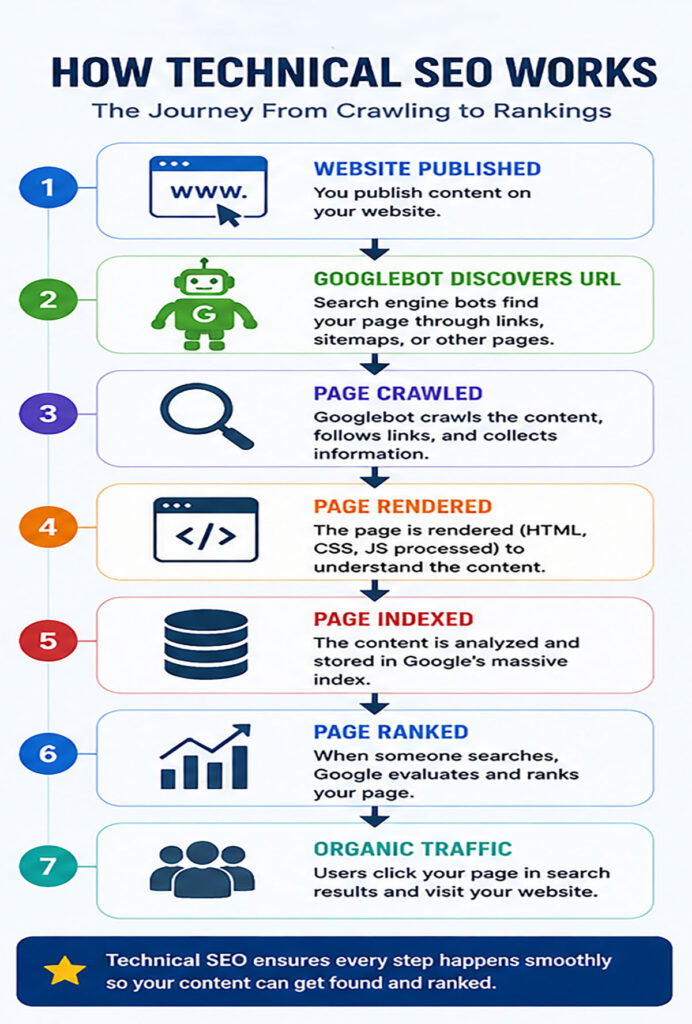
Technical SEO Workflow Explained
Understanding the technical SEO workflow prepares new people to understand how and where problems can arise.
The sequence could be broken down like this:
Discovery → Crawling → Rendering → Indexing → Ranking
Each one of the pages hosted on a website should be able to pass through all these steps in order to become a source of organic visitors. If, at any step, a page gets blocked, then it is quite probable that its ranking will suffer, no matter how good the content is.
For instance:
Great content might be present on a page, but if it gets hidden from the crawling by search engines, it may never get to the indexing phase.
On the other hand, the page could be indexed but if it loads at a snail’s pace, this will give off signals of negative user experience which will, in turn, limit its ranking potential. Technical SEO is aimed at enhancing each step of the workflow mentioned above.
What Happens When Technical SEO Is Poor?
Many websites don’t rank well, not simply because of poor content, but mainly due to hidden technical issues that no one even knew about. Technical problems usually go unnoticed until there is a drop in organic traffic. Poor Technical SEO can impact the performance of a website in various ways.
For instance, search engines may not be able to find key pages. Great content might never get indexed. People might leave because of slow load times. Mobile users might find the site difficult to use. Duplicate content might confuse search engines. Weak internal linking might limit how well authority is passed around.
Such difficulties, if unmanaged, can totally derail organic growth. Consider, as a typical example, the problem of orphan pages. These pages are indeed part of a website, but are not linked to by any other page internally. As a result, search engines have a tough time finding orphan pages, and such pages hardly get any organic traffic even if they have valuable content.
Another regular problem is related to websites that load slowly. Studies show time and again that users tend to leave pages that take too long to load. Because search engines notice this user behavior, they generally give a higher ranking to quicker, more user-friendly websites. Technical SEO can pinpoint these issues and fix them, thus preventing them from turning into serious ranking barriers.
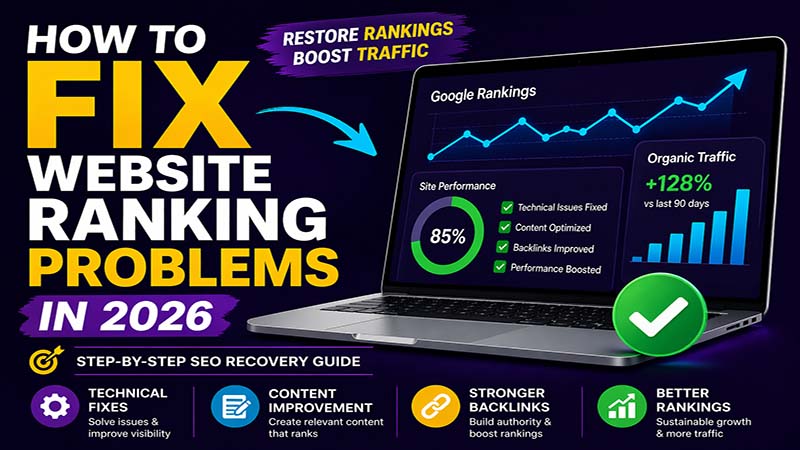
The good news is that most of these issues can be identified and resolved with the right optimization strategy. If your website is experiencing declining rankings, indexing issues, or poor organic performance, read our How to Fix Website Ranking Problems guide for practical solutions to diagnose and resolve the technical and SEO issues limiting your website’s visibility.
Signs Your Website May Have Technical SEO Problems
Many website owners do not realize technical problems exist until rankings begin falling.
Common warning signs include:
- Pages not appearing in search results
- Sudden drops in organic traffic
- Slow page loading times
- Poor mobile usability
- Frequent crawl errors
- Indexing issues in Search Console
- Duplicate content warnings
- Broken internal links
- Poor Core Web Vitals scores
Identifying these signals early can prevent larger SEO problems in the future.
Why Technical SEO Is the Foundation of Every SEO Strategy
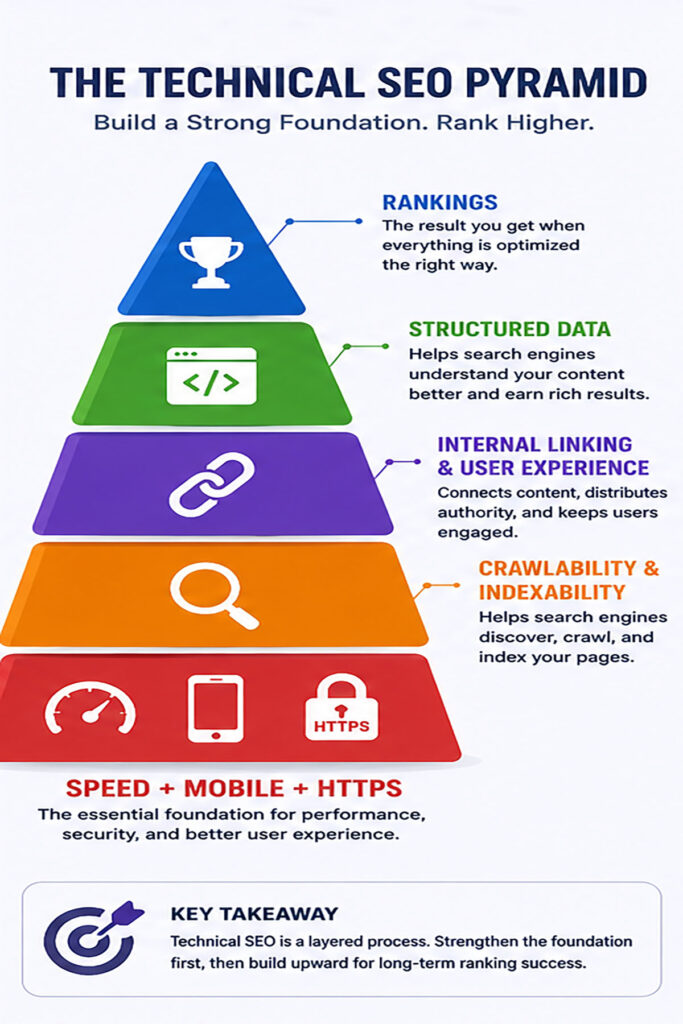
Technical SEO is so vital that it is likened to the foundations of a building. Content, backlinks, and user engagement are the elements of the visible structure. It is the technical SEO that forms the foundation holding these elements up.
Not even the best content strategy will succeed without a solid foundation. Properly executed Technical SEO maximizes the impact of other SEO activities by making it easy for search engines to find, understand, and judge content. Hence, it is the norm for SEO experts with a lot of experience to carry out technical audits first before going all in on content creation or link-building campaigns.
A website that is technically optimized has the resilience required for natural search results growth, enhanced rankings, better user experiences, and higher visibility not only in traditional search but also in AI-enhanced search platforms.
Core Components of Technical SEO
For better grasping purposes, know that technical SEO consists of various core components. These components have a major impact on your site’s performance in search engines since they affect how the search engines find, interpret, comprehend, and ultimately rank your website. On the one hand, a significant portion of website owners is preoccupied with producing content only. On the other hand, the technical groundwork that supports the content is the key that opens the door to the highest ranking possibilities of that content.
Every element plays a role in the search engine environment. When combined, they form a structure that not only allows search engines to smoothly find the content but also ensures a pleasant and dependable user experience for visitors.
Crawlability: Helping Search Engines Discover Your Content
What Is Crawlability?
Crawlability is a measure of how well a search engine can access, navigate, and discover pages throughout a website. To understand websites, search engines deploy automated bots, web crawlers, or spiders. These crawlers follow internal links, XML sitemaps, and URLs they have seen before to move from one page to another.
If a page can’t be crawled by a search engine, its content cannot be evaluated or ranked. Therefore, crawlability is arguably the most crucial area of Technical SEO.
Why Crawlability Matters
Organic traffic is only generated from discovered pages, so the first step is getting search engines to find a page.
Suppose you post a detailed article on your site and expect traffic to come, but it never does. It is usually not the quality of the content that is the culprit, but the fact that search engines have not successfully found the page.
Good crawlability supports search engines to:
- Find new content faster
- Revisit updated content more frequently
- Understand website structure
- Allocate crawl resources efficiently
A site that is easy to crawl is more likely to have its important content featured in search results.
Common Crawlability Problems
Many websites unintentionally create barriers that prevent efficient crawling.
Examples include:
- Broken internal links
- Excessive redirect chains
- Orphan pages
- Incorrect robots.txt settings
- Server errors
- Poor navigation structures
These issues make it harder for search engines to discover and process valuable content.
Best Practices for Improving Crawlability
Improving crawlability starts with developing a coherent website layout, which is further reinforced by robust internal linking. Website administrators should perform a crawl error check on a regular basis, keep XML sitemaps up to date, remove unnecessary redirects, and guarantee that main pages are always accessible through navigation and contextual links. The simpler it is for search engines to navigate through a website, the more effectively content can be discovered and evaluated.
Indexability: Ensuring Pages Can Appear in Search Results
What Is Indexability?
Indexability is the feature of a webpage that makes it possible to be included in a search engine’s index. E.g., a webpage might be crawled successfully but still be left out of the search engine results due to indexing problems.
Indexability regulates the eligibility of a webpage in the eyes of search engines for ranking. Organic visibility cannot be attained without good indexability.
Why Indexability Is Important
Search engines keep very large databases with billions of pages. Once a page gets indexed, it is in this enormous database of pages and hence can be shown in search results.
Pages not being indexed means search engines don’t take them into account at all for ranking. That is why it is very important to check the index coverage as part of technical SEO regularly.
Common Indexing Issues
Many kinds of technical problems can cause the search engine to not index the pages.
Examples:
- Noindex directives
- Duplicate content
- Canonical tag errors
- Blocked resources
- Soft 404 errors
- Poor content quality
Addressing these problems will unlock most of the visibility and search results potentials.
How to Improve Indexability
Administrators of websites are advised to keep a check on indexing performance through Google Search Console frequently. Any page deemed significant should still be accessible, distinct, as well as valuable, and not suffer from unnecessary restrictions. When you add proper indexability to robust crawlability, you end up with a very good base for organic progress.
XML Sitemaps: Roadmaps for Search Engines
What Is an XML Sitemap?
An XML sitemap or Site map in XML format is a document where a set of major URLs from the site are listed. You may see it as a kind of a map which guides a search engine to the pages that the site owner wants to be found first.
Of course, search engines can spot the pages of a site even through internal linking, but sitemaps make the whole process more effective and highlight at least some of the pages which might be important.
Why XML Sitemaps Matter
XML sitemaps are extremely helpful for:
- Large websites
- E-commerce stores
- New websites
- Websites with deep page structures
- Frequently updated content
If a sitemap is created and kept up to date, it greatly enhances the chances of content being found and helps the content get indexed rapidly.
XML Sitemap Best Practices
You should ensure that your XML sitemaps include:
- Indexable pages only
- Updated URLs
- Proper canonical versions
- Accurate status codes
Website owners should regularly review and submit sitemaps through Google Search Console.
Robots.txt: Managing Search Engine Access
What Is Robots.txt?
The robots.txt file is used for giving instructions to search engines to let them know which parts of a website should or should not be crawled. This is basically a tool for communication between the website owners and the search engine crawlers. Although robots.txt does not directly determine whether a page is indexed or not, it largely affects the way the site is crawled.
Why Robots.txt Is Important
The search engines have only a limited number of crawl resources that they can assign to each website. Robots.txt can be used to draw attention to the content that is most important and, at the same time, lessen the crawling of the pages that are of low value. This helps to improve crawler efficiency and resource allocation.
Typical Robots.txt Errors
By far, one of the most harmful technical SEO errors is the accidental blocking of the most important pages. Sometimes, website owners prevent the search engines from accessing whole sections of a site without fully understanding the consequences. Conducting periodic checks of your robots.txt is a good practice for making sure it works in favor of your SEO performance rather than against it.
Website Architecture: Building a Search-Friendly Structure
What Is Website Architecture?
Website architecture refers to how pages are organized and connected throughout a website. A clear structure benefits both users and search engines. Strong architecture helps visitors find information quickly while helping search engines understand topic relationships.
Why Site Architecture Matters
Search engines use website structure to evaluate content hierarchy and topical relevance.
Well-organized websites often experience:
- Better crawl efficiency
- Improved indexing
- Stronger user engagement
- Enhanced topical authority
Poor structures can create confusion and reduce visibility.
The Ideal Website Structure
Most SEO professionals recommend a logical hierarchy:
Homepage
→ Category Pages
→ Subcategory Pages
→ Content Pages
This structure helps distribute authority and improves navigation.
Internal Linking: Connecting Content Strategically
What Is Internal Linking?
Making an internal link means that you are linking one page to another page on the same site. Besides helping visitors to find relevant content, the links also support search engines in identifying how topics are related. Internal linking is still a huge Technical SEO area that most people neglect or are not even aware of.
Why Internal Links Matter
Search engines use internal links for these purposes:
- Discover content
- Understand page importance
- Transfer authority
- Build topic relationships
Well-developed internal linking has a major role in topical authority as well as semantic relevance.
Internal Linking and Entity SEO
Nowadays, search engines focus over entities instead of checking the keyword only. By linking relevant pages with internal links, search engines understand well the relationships between different concepts.
As an example:
A Technical SEO guide may refer to the following topics:
- Core Web Vitals
- XML Sitemaps
- Robots.txt
- Schema Markup
- SEO Audits
These connections play a role in strengthening topical authority.
Canonical Tags: Managing Duplicate Content
What Are Canonical Tags?
Canonical tags highlight the primary version of the page, especially when several URLs are quite similar. They assist in gathering ranking signals and, at the same time, mitigate the spreading of confusion.
Why Canonicalization Matters
When duplicate content exists, it can not only reduce the web authority of a site but also cause difficulties in indexing. Canonical tags, by clarifying which page is to be credited with ranking, help prevent such problems. Moreover, they enable the search engines to better understand the website and, at the same time, protect the SEO benefits.
Common Canonical Issues
Among the problems set by website owners, there are often:
- Self-referencing errors
- Incorrect canonical targets
- Multiple conflicting canonicals
One of the best ways to keep such issues at bay is through regular audits.
Structured Data and Schema Markup
What Is Structured Data?
Structured data represents a shared and consistent format that can simplify the task of search engines to quite thoroughly grasp the main drift of a piece of content. It conveys meanings that are not simply present in the written words of the page. Schema markup is a set of structural data standards which are very widely used.
Why is Structured Data Important
Increasingly, search engines are relying on structured data to create:
- Rich snippets
- Knowledge panels
- AI summaries
- Enhanced search results
When done right, the implementation of structured data can lead to higher chances of content being understood and found via search.
Structured Data & AI Search
Artificial intelligence machines dig into the structured data to be able to figure out entities, their connections, and the overall situation.
Many websites that have adopted schema markup accurately are in a position to send to search engines much clearer clues regarding:
- Organizations
- Authors
- Articles
- Products
- FAQs
- Reviews
These signals support AI-powered search experiences.
HTTPS Security: Building Trust and Protection
What Is HTTPS?
HTTPS encrypts communication between users and websites.
This security layer protects information and improves trust.
Why HTTPS Matters for SEO
Google has used HTTPS as a ranking signal for years. Secure websites generally provide better user experiences and stronger credibility. Visitors are also more likely to trust websites displaying secure connections.
HTTPS Best Practices
Website owners should ensure:
- SSL certificates remain active
- HTTP URLs redirect properly
- Mixed content errors are eliminated
- Secure connections function correctly across all pages
Security remains a critical component of modern Technical SEO.
Entity SEO and Technical SEO
Technical SEO and Entity SEO work more and more hand in hand. Entity SEO mainly concentrates on enhancing search engines’ understanding of persons, places, organizations, concepts, and relationships instead of just going back to keywords.
Technical SEO helps Entity SEO by:
- Using structured data
- Doing internal linking
- Having a clear site architecture
- Doing semantic organization
- Making content accessible
The more AI search evolves, the more entity understanding matters. Nowadays, search engines do not only do a word match. They also look at the relationships between the entities, topics, and even user intent.
Those combining Technical SEO with Entity SEO will likely create strong topical authority and enjoy long-term visibility.
Important point
Technical SEO is made up of a series of interlinked components all aimed at increasing visibility in search.
- Crawlability helps search engines discover content.
- Indexability allows pages to appear in search results.
- XML sitemaps guide content discovery.
- Robots.txt improves crawl management.
- Website architecture strengthens organization.
- Internal linking builds topic relationships.
- Canonical tags prevent duplicate content issues.
- Structured data improves understanding.
- HTTPS builds trust.
All these points/ elements combined build the technical base that is necessary for organic growth to be sustainable and have stronger visibility in both regular and AI-powered search contexts/maps.
Mobile SEO and Technical Optimization
Why Mobile SEO Matters
Mobile accounts for the majority of worldwide web traffic. That’s why search engines nowadays rely mostly on the mobile version of a website for crawling, indexing, and ranking, as they operate with mobile-first indexing. This approach to indexing implied that mobile versions of sites are mainly used for crawling, indexing, and ranking steps.
If your site is not giving a good experience to users of mobile phones, your rankings may be negatively affected even if the desktop version is perfect.
Technical SEO plays a critical role in that point, ensuring that mobile users can not only access the content easily but also find, use the navigation, click on buttons, and read the information comfortably.
Besides that, developing a site that is friendly for mobile devices will help you to enhance the user experience, increase engagement metrics, and improve your search visibility.
Understanding Mobile-First Indexing
Mobile-first indexing is a practice where the first evaluation of content by search engines is done on the mobile version of the site instead of the desktop version.
Due to this, webmasters need to:
- Mobile and desktop content remain consistent.
- Important content is not hidden on mobile devices.
- Navigation is easy to use.
- Fonts remain readable.
- Images scale correctly.
- Interactive elements function properly.
As a result of getting mobile usability changes done, search engines will be able to comprehend and assess the content much better.
Core Web Vitals: Measuring User Experience
What Are Core Web Vitals?
Core Web Vitals are a set of key measurement indicators for performance that describe the experience of real-world users. Web search engines consider these indicators for visitors’ website interaction evaluation.
The three main Core Web Vitals indicators are related to the performance of the website with loading, responsiveness, and visual stability. In general, a website offering good performance in these areas is capable of providing a pleasant user experience.
Largest Contentful Paint (LCP)
LCP is a metric for measuring how fast the biggest content of the page renders.
After a user clicks on a search result, they want the content to be displayed fast.
High load time can make users leave, and lead to fewer interactions.
Besides upgrading the server, image optimization and page streamlining can be used to get better LCP metrics.
Interaction to Next Paint (INP)
INP quantifies the amount of time a page takes to react to the user interaction.
Users expect UI elements like buttons, form inputs, and menus to be instant in their reaction.
Responsive web design is a way to increase the ease of use as well as the satisfaction of the users.
Cumulative Layout Shift (CLS)
CLS is a metric for measuring visual stability.
The unexpected shifting of the layout when a page is loading may be very irritating for users, and the experience could be even rated as poor.
Less layout shifting leads to a more stable and more predictable UI.
Why Core Web Vitals Matter for SEO
Search engines provide ways to help users get quality experiences. Websites which get up fast, answer quickly, and keep their layout stable are those which satisfy users. Of course, Core Web Vitals are not the only ranking factors, yet they make a significant contribution towards overall page experience and technical excellence together.
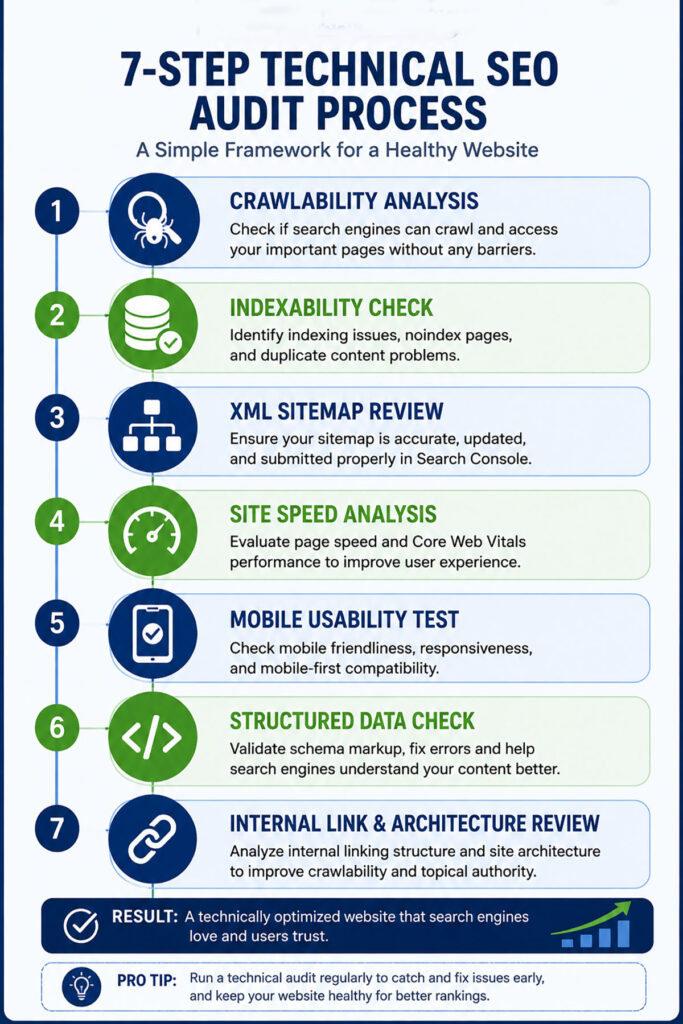
How to Perform a Technical SEO Audit
What Is a Technical SEO Audit?
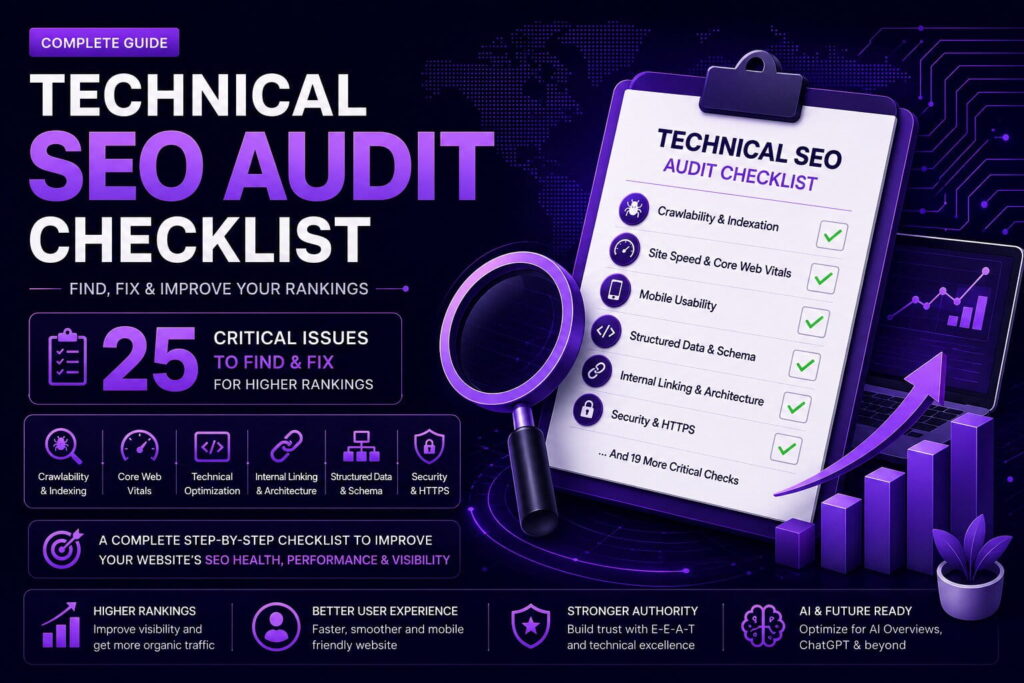
Technical SEO audit essentially entails a check-up of a website’s overall health. During a technical SEO audit, the goal is to identify issues that may prevent search engines from crawling, indexing, understanding, or ranking your content effectively. Regular audits help uncover hidden problems before they negatively impact your website’s organic visibility and performance. If you’re ready to evaluate your site step by step, follow our Technical SEO Audit Checklist to identify, prioritize, and fix the most critical technical issues that affect search rankings.
Step 1: Review Crawlability
Begin by checking whether search engines can access important pages.
Look for:
- Crawl errors
- Broken links
- Redirect chains
- Blocked resources
Resolving crawlability issues improves content discovery.
Step 2: Analyze Indexing Status
Review indexed pages using Google Search Console.
Identify pages that:
- Are excluded from indexing
- Contain noindex directives
- Have duplicate content problems
Ensuring proper indexability helps maximize search visibility.
Step 3: Check XML Sitemaps
Verify that your sitemap contains:
- Important URLs
- Correct canonical versions
- Active pages only
An accurate sitemap supports efficient crawling and indexing.
Step 4: Evaluate Website Speed
Analyze page performance using speed-testing tools.
Review:
- Loading times
- Core Web Vitals
- Image optimization
- Server response times
Speed improvements often enhance both SEO and user experience.
Step 5: Review Mobile Usability
Test website functionality on multiple devices. Ensure content remains readable, navigation works correctly, and interactive elements are easy to use.
Step 6: Validate Structured Data
Check schema implementation for errors. Proper structured data helps search engines understand content and can improve search result enhancements.
Step 7: Analyze Internal Linking
Review how pages connect throughout the website. Strong internal linking improves crawlability, authority distribution, and topical relevance.
Step 8: Monitor Security
Verify HTTPS implementation and eliminate security warnings. A secure website builds trust with both users and search engines.
Technical SEO Tools Every Beginner Should Know
Technical SEO becomes far easier and hassle-free when assisted by the right tools that can do a significant part of the grunt work with the minimum involvement from you. These tools not only help you fix problems, but they also allow you to monitor the website’s health and identify areas for improvements.
Google Search Console is a comprehensive tool that allows you to check what Google knows about your site and what Google sees when crawling pages for your site. Indexing and crawling-related features help uncover visibility problems and provide information on how well Googlebot can see your site.
On the other hand, Google PageSpeed Insights mainly helps to assess the speed of page loading and the Core Web Vitals of the website. Another tool that is really valuable when it comes to SEO is Screaming Frog SEO Spider, which not only helps the spider of search engines crawl through your websites but also provides in-depth information on technical audits of your websites.
Besides, there are some platforms like Ahrefs and Semrush, which provide you with technical site audit capabilities, backlink analysis, and SEO reporting. If you habitually use these tools for your SEO tasks, you will definitely find it easier to monitor your technical health and uncover any areas that can lead to optimization of your websites.
Technical SEO vs On-Page SEO
Techniques involved in technical SEO ensure that search engines can efficiently crawl, understand, and index your website. This includes optimizing server configuration, content delivery networks (CDNs), URL structure, XML sitemaps, robots.txt, structured data, Core Web Vitals, site speed, mobile usability, and other technical elements that improve website accessibility and performance.
In contrast, on-page SEO focuses on optimizing the content and HTML elements that both users and search engines interact with directly. This includes keyword optimization, high-quality content, heading structure, title tags, meta descriptions, internal linking, semantic relevance, and search intent optimization.
Imagine a website with exceptional content but unresolved technical SEO problems. If search engines cannot properly crawl or index its pages, that content may never appear in search results, significantly limiting its organic visibility and rankings.
To ensure every page follows on-page optimization best practices, explore our On-Page SEO Checklist, which provides a practical framework for optimizing content for both users and search engines.
Likewise, a technically flawless website without valuable, relevant, and well-optimized content is unlikely to rank for competitive search queries. Technical SEO helps search engines access your website, while on-page SEO helps them understand its relevance and value. Both work together to improve search visibility, user experience, and long-term organic growth.
Technical SEO vs Off-Page SEO
Technical SEO is all about making a website work well and it being a joy to navigate. Off-Page SEO is about having a site with good reputation and is seen as an authority. Off-Page SEO includes backlinks, digital PR, mentioning of brand on the internet, and various signals that represent external trust.
Technical SEO consists of site speed, structured data, mobile usability, crawlability, and indexing. Each aspect makes its contribution to the long-lasting ranking success
Technical SEO and AI Search Optimization
How Search Is Changing
The technology is rapidly improving, so even simple word recognition and matching are just a part of it. Now, with the help of machines that mimic thought processes and behaviors in human beings, such as artificial intelligence, they are able to grasp the meaning behind the word, the connections among things, the main purpose, and even how one entity can be connected to another entity.
A contemporary search engine tries very hard to be a little like a human being and to be just a bit less like a computer in that aspect, in the sense that it is very hard for computers to understand language. Machines and computers have always had a very difficult time making sense out of natural language and even more so with regard to understanding and comprehending the content.
Why Technical SEO Supports AI Search
AI systems depend on clear information structures.
Technical SEO helps by providing:
- Accessible content
- Structured data
- Entity relationships
- Clear website architecture
- Strong internal linking
- Fast page performance
These signals help AI systems understand topics and generate accurate responses.
The Role of Entity SEO
Entity SEO focuses on helping search engines understand concepts rather than individual keywords.
For example, a Technical SEO article may contain entities such as:
- Google Search Console
- Core Web Vitals
- XML Sitemap
- Schema Markup
- Googlebot
- Mobile-First Indexing
When these entities are properly connected through content and internal links, search engines gain a deeper understanding of topical relationships. This strengthens topical authority and improves visibility.
Why Semantic SEO Matters
Semantic SEO expands content coverage beyond primary keywords. If “Technical SEO” is not constantly used as the focus, it will still get covered extensively throughout the page as part of discussing closely related ideas, questions, and so on.
This mode of working is almost the same as the way AI algorithms judge for expertise and topical richness. Semantic optimization enables websites to reach wider audiences with their content while keeping the message relevant and engaging.
The Future of Technical SEO
As the world of search gets smarter, Technical SEO has to adjust as well.
Next stage of optimization is likely to focus on the following major areas:
- Being visible to AI-powered searchers
- Mapping of entities
- Organizing information
- Happiness of visitors
- Availability to people with disabilities
- Visibility (content-wise) of a web presence
The search systems have grown smarter in reading context and intentions. Websites that have solid Technical SEO are going to enjoy better chances in case search engines decide to switch algorithms once again. Indeed, the role of Technical SEO is far from diminishing but is on a growth trajectory.
Frequently Asked Questions
What is Technical SEO in simple terms?
Technical SEO improves the technical foundation of a website so search engines can crawl, index, understand, and rank content more effectively.
Why is Technical SEO important?
Technical SEO helps search engines access content efficiently while improving user experience and search visibility.
Does Technical SEO directly improve rankings?
Technical SEO removes barriers that may prevent strong content from achieving its ranking potential.
What is crawlability in SEO?
Crawlability refers to a search engine’s ability to discover and access website pages.
What is indexability in SEO?
Indexability determines whether pages can be stored in search engine indexes and appear in search results.
What is an XML sitemap?
An XML sitemap is a file that helps search engines discover important pages across a website.
What is robots.txt?
Robots.txt provides instructions about which website areas search engines should crawl.
What are Core Web Vitals?
Core Web Vitals are performance metrics that measure loading speed, responsiveness, and visual stability.
What is mobile-first indexing?
Mobile-first indexing means search engines primarily evaluate the mobile version of a website.
What is structured data?
Structured data provides additional context that helps search engines understand content more accurately.
How often should I perform a Technical SEO audit?
Most websites benefit from quarterly audits, while larger websites may require more frequent reviews.
What tools are used for Technical SEO?
Common tools include Google Search Console, Google PageSpeed Insights, Screaming Frog, Ahrefs, and Semrush.
Is Technical SEO difficult for beginners?
Technical SEO can seem complex initially, but understanding core concepts makes implementation much easier.
Does page speed affect SEO?
Page speed influences user experience and contributes to overall website quality signals.
What is the future of Technical SEO?
The future of Technical SEO involves AI search optimization, entity understanding, semantic relationships, and enhanced user experiences.
Conclusion
Technical SEO basically means optimizing a website technically so it becomes as search engine-friendly as possible. It is actually the underlying support of whatever SEO strategy is taken for that a website can appear at the top of the search results.
In fact, in order for any content to be ranked, search engines need to first find, crawl, render, index, and comprehend the content. Technical SEO enables this cycle of actions to be smooth at the same time giving visitors a fast, secure, and user-friendly experience on the site.
The importance of Technical SEO lies in several facets. It involves making a website crawlable and indexable. Also, the Core Web Vitals are taken into account. Then there’s structured data, which is nothing more than a data format that has been defined so it can be machine-readable. Mobile usability comes into play in addition, as nowadays more people browse the internet on their mobile devices. Entity optimization is a further facet of Technical SEO that helps search engines find related information.
Every one of the above technical aspects is a building block of the overall Search Engine Visibility. In fact, it’s getting more and more relevant as search engines are turning more and more to machine learning, semantic knowledge, and the use of entities to understand the web better through the relations among them. So, with time, the contribution of Technical SEO to your site’s performance will even be more significant.
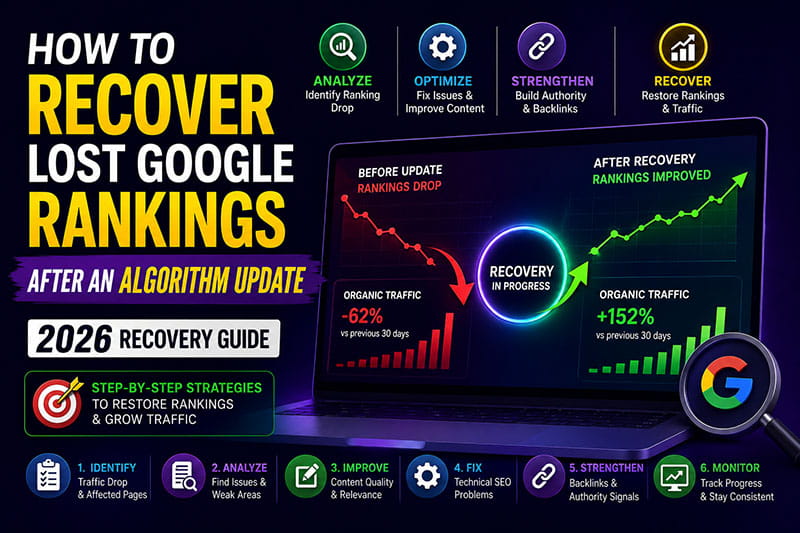
Whether it’s your personal website, a blog, an e-commerce platform, or a corporate one, you can still be confident that by optimizing the technical aspect of your site, you will have put together a solid backbone that helps you in organic search results for a longer period of time. It’s just not enough to be technically great. Thereafter, the content must be of the highest level, you must have authority on a topic, and you should also make the site user-friendly. When these elements all come together, then such a site or blog is likely to be the best place to go in search of information, whether the results are from traditional searches or they come about by AI. If your website has already experienced a decline in organic visibility, explore our How to Recover Lost Google Rankings After an Algorithm Update guide to understand the possible causes and the practical steps you can take to regain your search performance.