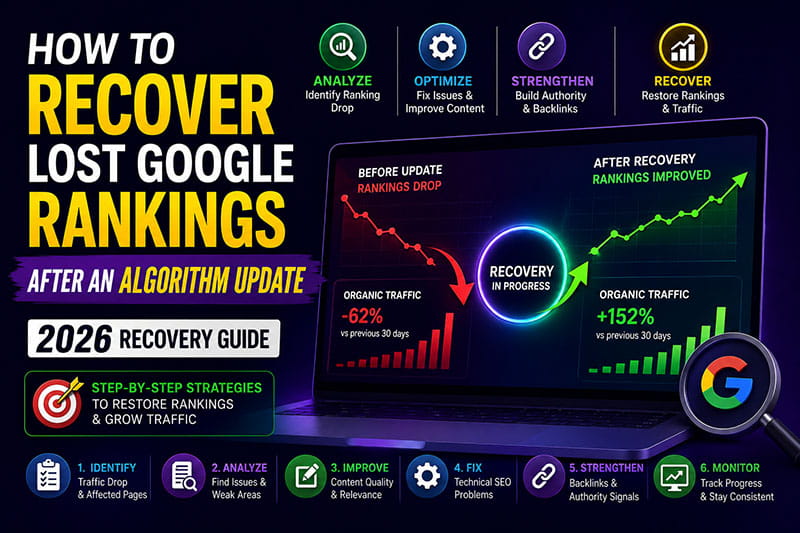
SEO (Search Engine Optimization) is the process of optimizing your website so that it appears in the results of search engines and AI-based tools when people are searching for products or services related to your business. SEO is the best way to increase visibility, traffic, and sales without spending a penny on advertising.
How Search Has Changed in 2026
Over the last decade, the way people find businesses has changed completely. Nowadays, people are not just using Google; they are using AI-based tools like ChatGPT, Google Gemini, and Perplexity AI to get instant recommendations.
They are not clicking through many websites; they are getting instant answers through AI-based tools. If your business is not optimized with these tools, then you are invisible to the majority of the potential customer base.
This guide is going to help you understand how SEO is done in 2026 and how to optimize your website for both search engines and AI-based tools.
Why SEO is More Important Than Ever in 2026
SEO has always been important, but it is just absolutely critical for small businesses. Here is why:
- AI & Voice Search Are Growing: More people are using voice assistants (Alexa, Siri, Google Assistant) and AI-powered tools to get answers. If your website is not optimized for these, the traffic will go to your competitors.
- Paid Ads Are Getting Expensive: It is good to run ads on Google or Facebook, but it is costly. Once you stop paying, the traffic disappears. SEO creates long-term organic visibility that continues to bring in customers without your constant spending.
- Trust & Credibility: People trust organic search results more than paid ads. Your small business gets authority and credibility instantly by ranking on the first page.
- Local Competition is Fierce: So whether you are a plumber, a dentist, a restaurant, or a retailer, your local competitors are also bidding for the spotlight. SEO guarantees your business will be the first to appear when users type ″near me″ in their searches.
- Future-Proofing Against AI Search: Google’s Search Generative Experience (SGE) and AI-driven search engines get answers directly from websites. However, optimizing for SEO ensures your business visibility as search changes.
SEO vs AI Search: What Changed?
“Search” is no longer defined by ranking on Google.
Google Search Generative Experience, for instance, allows users to read AI-generated answers at the top of search results. This information is derived from trusted websites.
Additionally, AI platforms are able to suggest businesses without the user visiting multiple websites.
This means that:
- Ranking #1 is no longer enough
- Your content must be selected by AI systems
- Clear, structured answers matter more than ever
In 2026, SEO is about visibility across Google + AI platforms, not just rankings.
Types of SEO You Must Know
SEO just isn’t a single entity; it is a combination of different strategies. Knowing the different types will help you create a more powerful online presence.
On-Page SEO
This means changing the things on your website to be better:
- Inserting main keywords in the title, headings, and content in a natural way.
- Producing clear, useful, and interesting content that meets the users’ needs.
- Adding the content with images, videos, and infographics, and providing alt text for them.
- Organizing the information on the website by using H1, H2, and H3 headings.
On-page SEO is what makes your website more or less ideal for Google and your users.
Off-Page SEO
Off-page SEO refers to the process of increasing the authority of your website externally from your own domain. The most important thing in this area is backlinks.
- If trustworthy websites link to you, Google considers your content reliable.
- Writing guest posts, influencer mentions, and issuing press releases are some of the ways to get quality backlinks.
- Besides, the signals from social media and mentions of your brand also help rankings to grow, although not directly.
Off-page SEO would be more like reputation management. In the same way as it works in society, the more people talk positively about your business, the more trusted you become.
Technical SEO
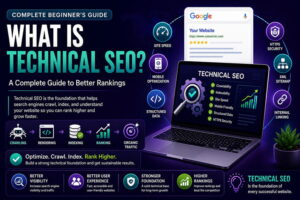
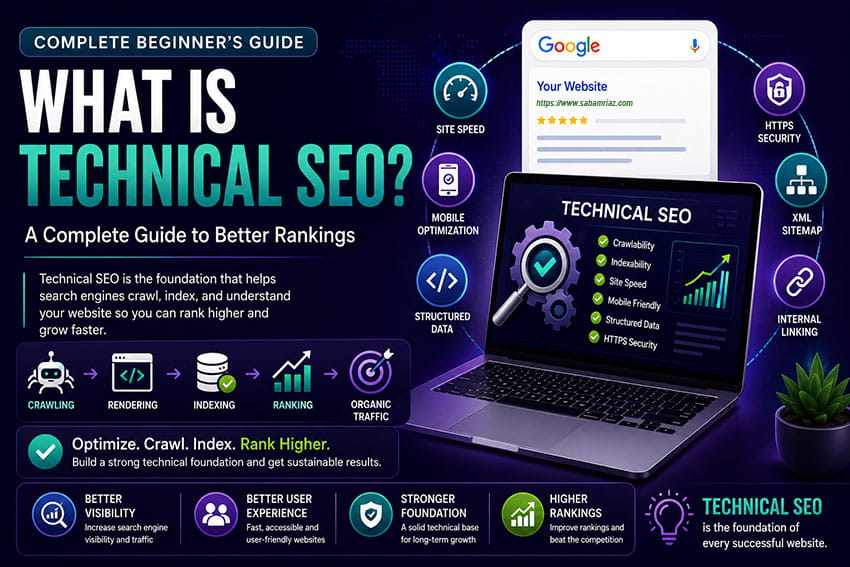
Technical SEO aims to ensure that your website is fast, secure, and that Google can easily access it.
Important elements:
- Page Speed: Slow sites drive away users.
- Mobile-Friendliness: More than 70% of the searches are done on mobile.
- Secure Website (HTTPS): Gives confidence to users and is a ranking factor.
- Clean Site Structure: Simple navigation and internal linking.
- Schema Markup: A language that makes it easier for search engines to get your content.
Even the most amazing content without technical SEO may not be able to rank if Google bots cannot properly index your site.
Local SEO
Typically, local SEO is the number one revenue generator for small businesses.
- Use Local SEO to actively manage your Google My Business (GMB).
- Put your NAP (Name, Address, Phone) in every directory to make it identical.
- Get more positive reviews from your clients.
- Find customers using local keywords such as “best pizza in New York” or “plumber near me.”
With the help of Local SEO, you can be found on Google Maps and in “near me” searches, which are usually very profitable as the users are on their way to a purchase.
AI SEO (NEW in 2026)
Introducing a new field, AI SEO. This post explores what it might look like to optimize content for AI systems. Instead of ranking on search engines, the goal is to get content selected and ranked by AI-powered tools.
This requires:
- Clear and direct answers
- Conversational language
- FAQ sections
- Strong topical authority
AI prefers content that is easy to understand and directly solves user problems.
How SEO Works – Step by Step
SEO might appear to be a complex maze, but when you dissect the process, you are able to see that it is very simple. However, the stages of the process can be outlined as follows:
- Crawling: Google bots (spiders) run through your website pages. If your site is not crawlable (because of broken links, blocked pages, or poor site structure), Google will not be able to find your content.
- Indexing: Following crawling, Google places your pages into its database. If your content is duplicate, thin, or low-quality, Google may not index it.
- Ranking: At the time of a search, Google picks the most relevant pages out of the indexed ones. It employs over 200 ranking factors such as keywords, backlinks, site speed, mobile optimization, and user engagement.
The more your site is optimized, the higher you will be. You could compare it with a library — crawling is finding books, indexing is putting them on shelves, and ranking is selecting the book that shows first when someone asks a question.
SEO Strategies for Beginners in 2026
These are easy and practical approaches that small companies are able to implement straight away:
- Do Keyword Research: Employ (Google Keyword Planner, SEMrush, Ubersuggest) to locate keywords that your clientele will be searching for.
- Create Long-Form Content: Blog in-depth posts on topics ranging from 1,500 to 2,500 words.
- Optimize for Voice Search: The addition of FAQs and using conversation-like phrases (for instance, “What is the best…?”) being some of the ways.
- Internal Linking: Allow the visitors (and the search engines) to smoothly move around by linking your blog posts and service pages.
- Improve Site Speed: Among the measures you can take are image compression, implementation of caching, and hosting with a reliable server.
- Leverage Local SEO: Utilize GMB, motivate the delivery of reviews, and go after location-specific keywords.
- Use Multimedia: Incorporate images, videos, and infographics to attract visitors.
Consistency is essential. By regularly publishing 2-3 blogs per week, you can establish your authority on the subject matter more quickly.
Common SEO Mistakes to Avoid
Numerous small businesses are unsuccessful in local search engine optimization as they consistently commit the same errors. The following are the main ones not to fall into:
Keyword Stuffing – Trying to overuse keywords in an unnatural way will make the text difficult to read and may also result in a Google punishment.
Duplicate or Copied Content – Simply by copying the competitors’ content will not help you to rank; creating original, high-quality content is the key.
Ignoring Mobile & Speed – If your site is slow, visitors will abandon it and your ranking will be affected.
No Backlinks – If your website is not linked to any other sites, it means it has no value.
Publishing Without Updating – Even the oldest blogs have to be regularly updated with new data to remain relevant.
These mistakes, if you steer clear of them, can save you from months of wasted effort and frustration.
Latest Trends in SEO (ALO, AEO, GEO in 2026)
Searching has changed. It is still about Google rankings but not only. AI and new technologies have changed the way people search for information.
ALO (Answer-Language Optimization)
ALO refers to tailoring the content of your website to meet the needs of AI-based systems such as ChatGPT, Gemini, and Perplexity. These tools draw answers straight from websites. In order for your content to be ranked here, it has to be written in an easy-to-understand, conversational style with direct answers and FAQs.
AEO (Answer Engine Optimization)
AEO is aimed at the featured snippets as well as the voice search. Google often provides a brief summary of the answer at the top of the page when a question is asked. So to optimize, one needs to write short and concise answers (50-60 words), use step-by-step instructions, and cover all the possible “how” and “what” queries.
GEO (Generative Engine Optimization)
GEO is concentrated on AI-driven search engines such as Google SGE (Search Generative Experience). These AI outcomes tap into the content of the most reliable sources. Companies have to produce comprehensive content, utilize schema markup and create clusters of interlinked blogs on one topic.
In combination with one another, ALO, AEO, and GEO will make your website ready for SEO’s coming changes. Companies that make these adjustments early will still be leading the game later.
Benefits of SEO for Small Businesses
SEO is the best ROI (Return on Investment) for small businesses, and here are the reasons why:
- Free, Targeted Traffic – Bring in the clients you want without spending money on advertisements.
- Evergreen Results- SEO, unlike ads, continues to function for a long time.
- Builds Trust & Authority – High rankings are equivalent to trustworthiness.
- Better Conversions – Users who find you through searches are pre-interested in what you offer.
- Scalable Growth – Ranking for new pages gets easier as your site authority increases.
Basically: SEO is like tree planting. It takes a while to develop, but once mature, it offers shade (traffic & sales) for years.